sabinene
floral terpene Key food odorantFound in 102 ingredients across the CompKitchen flavor graph.
Look up another compound — search by name, CAS number, PubChem CID, or FEMA #.
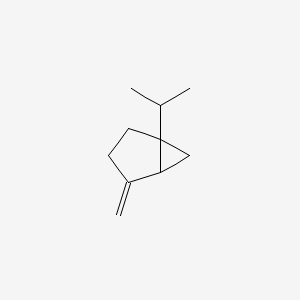
- Formula
- C10H16
- Molecular weight
- 136.23 g/mol
- PubChem CID
- 18818 — full record on PubChem
Key food odorant (individualist)
Dunkel et al. 2014Identified in the meta-analysis of 227 food samples as one of 151 individualist odorants — appears in <5% of foods, carries the diagnostic signature of specific ingredients.
Properties
- Odor description
- woody, terpenic, spicy, citrus, pine
- Odor threshold — in a food matrix
- 0.600 ppb – 517 ppb median 6.0 ppb · 11 published values · see all 12 with sources
- Volatility
- high
- CAS number
- 3387-41-5
- Retention index
- 973
FEMA GRAS — Generally Recognized As Safe for flavoring use
- FEMA number
- 3239
- GRAS publication
- GRAS 4
- FEMA primary name
- 4-THUJANOL Sabinenehydrate
Use-level matrix not extracted for this substance — check the source publication for current ppm guidance.
How this molecule is described
Sources disagree about odour more often than they disagree about chemistry. Rather than show one answer, here is every description on file with how many ingredient records carry it.
Ordered by how many independent descriptor streams give each wording, then by how often it appears. The bar is still replication — one source copied onto many ingredients scores high there — so the two can disagree.
Bars are the share of ingredient records carrying each description. High agreement means the sources replicate each other — not necessarily that they are right.
Published thresholds
12 measured values from the literature. Grouped by what was actually measured — a threshold smelled in clean water, tasted in the mouth, or measured in a real food are three different quantities and are not pooled.
In a food matrix
0.600 ppb – 517 ppbMeasured in a real food, where the matrix shifts detection — not a clean-water value.
| Threshold | Matrix | Source | Paper |
|---|---|---|---|
| 0.600 ppb | water (food: milk) | Literature corpus | 39824497 |
| 1.2 ppb | water (food: lemon) | Literature corpus | 20862741, 30009387, 31502246 +3 |
| 1.4 ppb | water (food: orange) | Literature corpus | 37515910 |
| 4.8 ppb | water (food: rice) | Literature corpus | 24708588 |
| 5.8 ppb | water (food: beer) | Literature corpus | 35292687, 38698043 |
| 6.0 ppb | water (food: tea) | Literature corpus | 21404434, 36540235, 41549111 |
| 8.0 ppb | water (food: tomato) | Literature corpus | 40950592 |
| 19.0 ppb SIDA | water (food: blueberry) | Literature corpus | 28490131, 12467918, 12710722 +124 |
| 517 ppb | water (food: rum) | Literature corpus | 16753919, 17487612, 35523852 +1 |
| 969 ppb SIDA | water (food: unknown) | Literature corpus | 28490131, 12467918, 12710722 +104 |
| Flagged: 160× from the median of this group. Excluded from the range above pending re-check against the source publication — shown rather than hidden. | |||
| 974 ppb SIDA | water (food: peach) | Literature corpus | 28490131, 40782165 |
| Flagged: 161× from the median of this group. Excluded from the range above pending re-check against the source publication — shown rather than hidden. | |||
Other matrix
6300 ppbMeasured in a non-aqueous medium (oil, starch, cellulose).
| Threshold | Matrix | Source | Paper |
|---|---|---|---|
| 6300 ppb SIDA | starch | Rychlik 1998 · 1 studies | — |
Only values we can attribute are listed. Where a compendium's licence does not permit public attribution its figures are omitted here, so every number on this page traces to a citable source.
Where you'd actually smell it
Odor Activity Value = measured concentration ÷ odor threshold (6.047499999999999 ppb, the engine's canonical value — see the 12 published values). OAV ≥ 1 = perceptible.
| Food | Concentration (ppb) | OAV | Source |
|---|---|---|---|
| tea | 974.0 | 161 ⚡ | Corpus paper |
| orange | 651.0 | 108 ⚡ | Corpus paper |
| rum | 509.1 | 84.2 ⚡ | Corpus paper |
| blueberry | 30.0 | 4.96 | Corpus paper |
| peach | 17.0 | 2.81 | Corpus paper |
| rice | 14.5 | 2.40 | Corpus paper |
| beer | 4.2 | 0.70 | Corpus paper |
| milk | 3.1 | 0.51 | Corpus paper |
| tomato | 2.0 | 0.33 | Corpus paper |
| lemon | 1.1 | 0.18 | Corpus paper |
Concentrations from PubMed Central Open Access papers (free literature corpus, MIT-style licensed). Copper = OAV ≥ 10 (strongly perceptible). Green = OAV ≥ 1 (perceptible).
Found in
Measured impact first, then profile shareEvery ingredient known to contain sabinene. Ingredients with a measured concentration come first, ranked by odour activity; the rest follow by how large a share of that ingredient's profile this molecule is. The figure beside each is how many different compounds that ingredient has in total — not the concentration of sabinene in it. Full concentrations are in the OAV table above.
The inverted compound index is a Pro feature — reverse-search any of 5,240 flavor molecules across the full graph.
Get a molecule-level pairing breakdown each week — which ingredients share a compound, and why it matters at the table. Free, no spam.
Prefer an account? Create a free account to save pairings and unlock the full chemistry.
Try the pairing tools to see which ingredient combinations rely on sabinene, or compare two ingredients side-by-side.