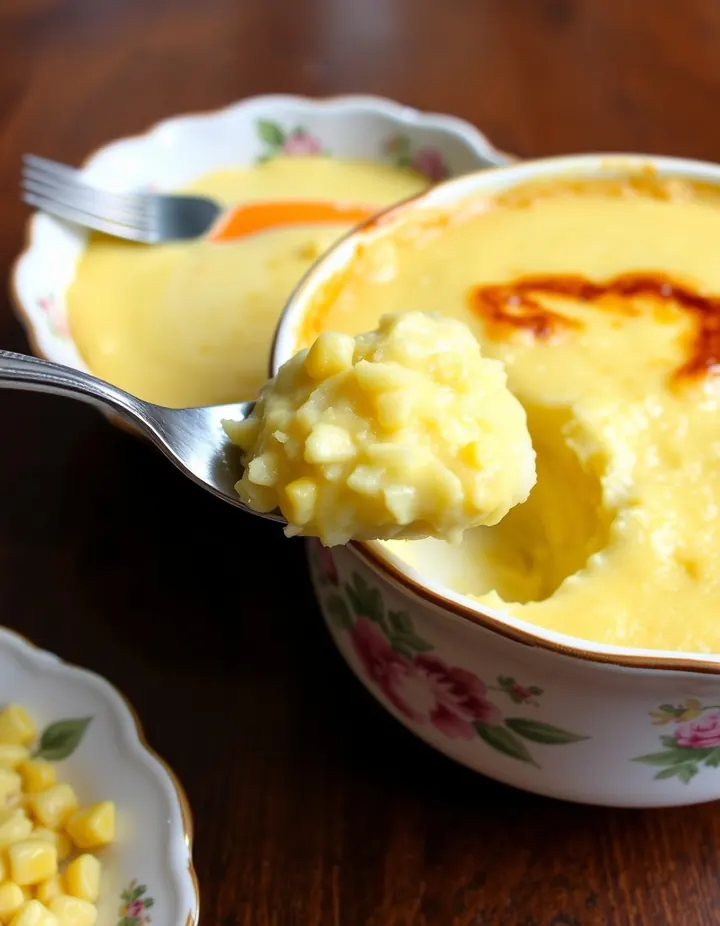
 Illustration
Why it works: Milk and corn match in chemistry and in kitchens. They rank in the top 4% of all ingredient pairs, and 6,953 recipes mention both. Both carry hexanal, which smells green, grassy. The science ↓
The recipe
Ingredients
Contains: egg, milk, wheat (auto-detected from the ingredients and method; we can miss things, so check labels)
Directions
Heat the oven to 350°F (175°C). Use a baking dish about 8 inches square or 1.5 quarts.
Cut the kernels from the ears of corn, then scrape the cobs to grate the pulp. Set the corn aside.
Melt the butter. In a large bowl, beat the eggs well, then whisk in the milk, sugar, melted butter and corn.
Season with pepper and salt. Do not taste the raw egg mixture. Pour it into the baking dish.
Bake about 1 hour, until the pudding is set in the centre and a knife inserted near the middle comes out clean. An instant-read thermometer should read 160°F (71°C).
Let the pudding cool for 10 minutes before serving. Refrigerate leftovers within 2 hours and eat within 3 to 4 days.
Original text from the book (21 steps)
Twelve ears of corn (grated), three eggs well beaten, one pint of sweet milk, one-half cup of butter, one tablespoonful of sugar, pepper and salt to taste. Bake one hour. .
Exchange Cook Book.
SUCCOTASH.
This is made of green corn and Lima, string, or butter beans. Have a third more corn then beans, when the former has been cut from the cob and the beans shelled. Put into boiling water enough to cover them, and stew gently together until tender. Pour off nearly all the water, and add a large cupful of milk. Stew in this for an hour; then stir in a great lump of butter, a teaspoonful of Hour wet with cold milk; pepper and salt to taste.
The foundation of the art of cookery is tlie ability to make good bread, since that is the most important article of diet, and upon its nutritive qualities the health of the family is likely to depend.
The first necessity for the making of good bread is pure materials, but since these are only four, it is very easy to get them. Flour, yeast, salt and water are the only necessary ingredients.
Good flour may be known by its creamy color. It is never blue white, and also by the test of squeezing it in the hand. If it is good, it will retain the shape into which it has been pressed.
There are many varieties of yeast; in fact, almost every cook has her especial kind, though the yeast germ is the same in all, and any yeast which will rise, and is not sour, is entirely satisfactory. Compressed yeast, when fresh, is, on the whole, the most convenient to use, as it shortens the pro- cess of bread making. Salt and water are certainly within the reach of all.
Exchange Cook Book. 59
Yeast is a fungoid plant, which grows in flour and water. This growth is accompanied by a fermentation which pro- duces alcohol and carbonic acid gas. When the bread has risen to twice its original bulk, it is put into an oven of more than three hundred degrees, which kills the yeast; the alco- hol has escaped, but the carbonic acid gas has formed bub- bles, which have made the bread light.
Bread always weighs more than the flour of which it is made, because some of the water is retained in it. One pound of flour usually makes a pound and a quarter of bread.
Yeast grows best at a temperature ranging between seven- ty-five and eighty-five degress.
A good loaf of bread ought to be of a uniform brown color, rounded on top, and of a sweet and nutty flavor. The reason so much bread is tasteless and even sour, is because it is allowed to rise too long.
Now as to the details of the process. I will take it for granted that my reader is a beginner in the art of bread- making. There are two ways of making bread, one is to "set a sponge," that is put the yeast in a soft batter of flour and water, the other is to mix it in dough immediately. As the latter process takes less time, and always produces good bread, I will describe that:
In one quart of luke-warm water dissolve one cake of com- pressed yeast and one heaping teaspoonful of salt. Remem- ber hot water would kill the yeast. Add flour until it is stiff enough to knead, without sticking to your hands or to the bread board, but not any more, or your bread will be dry. Knead it until the yeast is thoroughly mixed with the other ingredients, then slip into a greased bowl. Grease the bowl so that you will not waste flour by having the dough stick to the bowl, and use a bowl of earthenware in preference to a tinpan, because it is so much thicker it will keep the bread at a more even temperature. Brush the to]) of the dough
60 Exchange Cook Book.
with melted butter, so that no hard crust will form. Cover your bread with a clean cloth and a blanket, and set it some place where the heat is not less than seventy-fire degress or more than eighty-five degrees, and where it will continue about the same. Don't put it too near a hot cook stove, and be equally careful about draughts. In about three hours your dough will have rounded up beautifully. As soon as it is twice its original bulk, it is ready to make into loaves. This quantity usually makes three loaves, or two and a pan of rolls. Knead for a few minutes, but without adding more fiour, form into loaves and place them in greased pans. Put melted butter on them, and let them rise an nour. Try your oven to see if it is hot enough. If you can just bear your hand in it while you count twenty-five slowly, it is about right. Bake them about an hour. A gas stove will bake bread in forty-five or fifty minutes, so something depends on the oven. When you take the bread out of the pans tap them on the bottom. If they give out a hollow sound they are done.
If you desire to make more bread at once, it is not neces- sary to increase the yeast in the same proportion. One cake of compressed yeast is enough to use with two quarts of water, and it will take it very little, if any, longer to use. I have not tested its lightenning qualities further than this. It might do for even more, but that I cannot vouch for.
The rolls made from this dough are very good, too. If rolled out and cut out with a biscuit cutter, spread with butter, and folded over they make pocketbook rolls, which are particularly nice.
Bread made according to these directions will always be good and sweet. It is not the only way to make good bread, but it is a sure and easy way.
ExcHAXGE Cook Book. 61
From a scanned old cookbook. The method has been rewritten by AI to follow current food-safety guidance (safe cooking temperatures, refrigeration, no raw-egg shortcuts). It hasn't been kitchen-tested. The original text is under the method. See the original page.
Found this recipe through an AI assistant? CompKitchen also shows which ingredients go well together and why, from the aroma molecules they share and how often recipes combine them. Try the pairing tools.
The picture is an illustration, not a photo of this recipe · Contact us to use it
Explore the science
The flavor team
The pairs that carry this dish. Each one is judged two ways: how much aroma chemistry they share, and how many recipes mention both.
-
Milk + corntop 4% of all pairsAroma overlapstrongMentioned together6,953 recipes
Shared aroma: hexanal (green, grassy).
-
Butter + breadtop 3% of all pairsAroma overlapstrongMentioned together27,145 recipes
Shared aroma: delta-decalactone (sweet, creamy).
-
Milk + buttertop 3% of all pairsAroma overlapstrongMentioned together81,222 recipes
Shared aroma: (z)-4-heptenal (biscuit, cream).
-
Milk + breadtop 4% of all pairsAroma overlapstrongMentioned together11,363 recipes
Shared aroma: 2-undecenal (sweet).
-
Egg + breadtop 6% of all pairsAroma overlapstrongMentioned together22,584 recipes
Shared aroma: 2-nonenal (fatty, green).
Ranks compare each pair with 20,000 random ingredient pairs on CompKitchen. How we score pairs
Make it your own
Stand-ins, a drink, and quick taste fixes for this dish, ranked by how well each fits its other ingredients: shared aroma molecules and how often recipes combine them.
You might also like
 Illustration
The Sunday pairing: one pairing, the chemistry behind it, and how to cook it. No spam, unsubscribe anytime.
Prefer an account? Create a free account for sign-in; Pro adds the full results and chemistry.