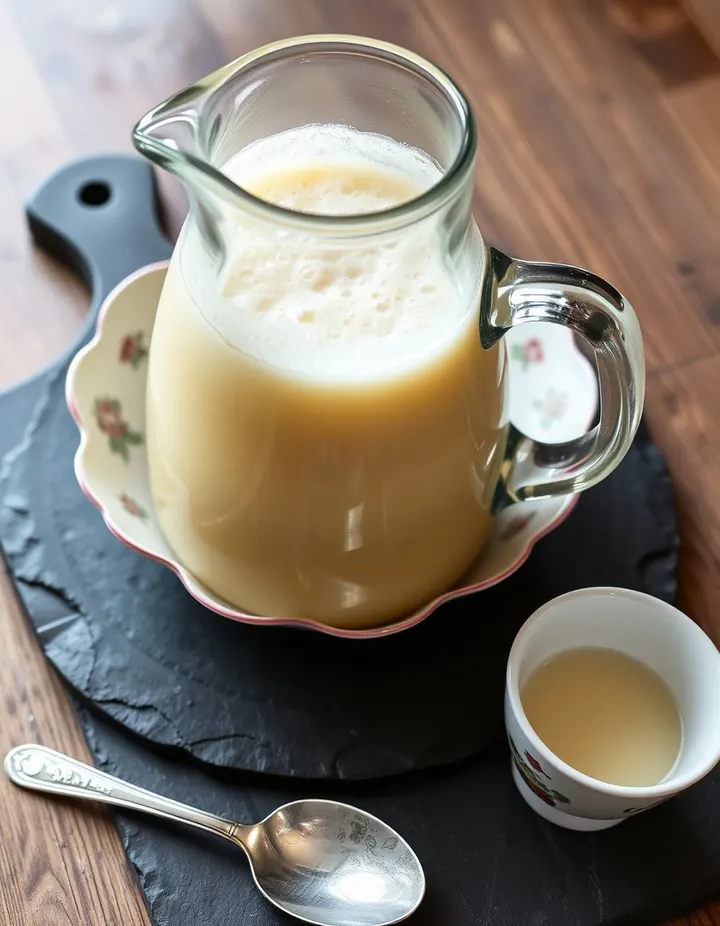
 Illustration
Why it works: Potato and wheat match in chemistry and in kitchens. They rank in the top 4% of all ingredient pairs, and 235 recipes mention both. Both carry 2-acetyl-1-pyrroline, which smells popcorn, roasted. The science ↓
The recipe
Ingredients
Contains: egg, milk, wheat, shellfish (auto-detected from the ingredients and method; we can miss things, so check labels)
Directions
Wash a large pot, a jar, a spoon and a bowl in hot soapy water, rinse well, and let them air dry. Peel four small Irish potatoes, grate them, and place them in the pot with two quarts of water.
Put one cup of hops in a clean cloth bag, add it to the pot, and boil until the water tastes bitter. Remove and discard the hop bag.
Add one cup of white sugar and one tablespoon of salt. Keep the mixture boiling and stir constantly for 5 to 10 minutes, until it thickens like starch.
Cool the mixture to lukewarm, about 85-95°F (29-35°C), within 2 hours. Stir in one-half pint of good yeast, first saving a spoonful to start the next batch.
Pour into a clean, large jar set in a large bowl or tin pan to catch any overflow. Cover loosely with a clean cloth. As it rises, stir it down until bubbling stops and it becomes thin.
Cover the jar with a tight lid and refrigerate. Use within 3 to 4 days. A good starter smells pleasantly sour, like beer. Discard it if it smells rotten, has mould, or shows pink or orange streaks.
Cook to a safe temperature. This method doesn't say how hot the inside should get. Check with a food thermometer in the thickest part:
- Chicken, turkey and other poultry: 165°F (74°C), and any stuffing inside it too.
- Beef, pork, lamb and veal steaks, chops and roasts: 145°F (63°C), then rest 3 minutes.
- Shellfish: shrimp, lobster and scallops until pearly and opaque; clams, mussels and oysters until the shells open (throw away any that stay shut).
Figures from the USDA's safe minimum internal temperatures.
Original text from the book (31 steps)
For reference only, not instructions. This text may include storage, bottling, preserving or cooking steps that don't meet current food-safety guidance. Use the method above.
Mrs. D. Buxton. Take four small Irish potatoes or three large ones, peel and grate raw, and place in a porcelain kettle with two quarts water; put one cup hops in a bag, drop in the kettle and boil until the water tastes bitter ; take out hops and add one cup white sugar and one table- spoon salt ; keep constantly boiling, and stir con- tinually ; cook from five to ten minutes, and when done it will boil up thick like starch; turn into a jar, and when, just tepid, in summer, or quite warm in winter^ add one-half pint good yeast, (always save some to start with.) Set jar in a large tin pan, and as often as it rises stir down until fermentation ceases ; (it will then be quite thin ;) tie up, and set away in a cool place and it will keep two weeks. When yeast smells,;?; sour but does not taste sour it is good ; if it has no smell it is dead. One cup will niake six good sized ' loaves, and if properly made you need never have
Missing Page
Mrs. layman's Recipes.
Faiibault BepitbUcau.
These recipes are kindly furnished
us by Mrs. Walter 0. Lyman, who is a gradu- ate of the London school of cookery. Some two weeks since Mrs. Lymua delivered a suc- cessful course o£ lectures to the ladies of Faribault, and at their request she consented ip the publication of the following recipes, which we take pleasure in commending:
BouP Stock — The base of soup should al- ways be leiu, uncooked meat, to which may be added chicken, turkey, bef or mutton bone!, well broken up. To four pounds of lean beef (the inferior parts are quite as good for this purpose) put five quarts of tepid soft water. Wast the meat and put it in the wa- ter without salt; let it come slowly to a boil ahd then skim well and set it back, aud let it simmer along for six or eight hours until the meat is in rags; then strain into an earthen jar, let it cool and remove all the grease. The stock will l^eep 'for many days, aad from it can bo made all the various kinds of soups. Whatever will be added to this, such al rice, tapioca, vegetables, etc., must be cuoked be- fore being added, as much boiling injures the flavor of the stock.
Pba Soup. — Two quarts of good stock, one quari of split peas or green peas, one tea- spoonful of while sugar. Soak the peas, if f-plit, over night, and then boil tender in just enough water to prevent them from Bcoiching: when tender, pass through a sieve, ar d add them to the stock; add pepper and salt to taste; let all come slowly to a boil; let the soup simmer slowly for thirty minutes, and just before leaving stir in a tablespoon- ful of butter in which has been Ptirred a tea- 'spoonlul of flour. Sirva hot, with chips of fried bread.,
Gkeen Cokn Soup— Most Delicate and DeIjIoiods. — One large fowl, or four pounds of veal — the knuckle and neck will do as well; put over in one gallon of cold water, without ^alt; cover tightly and simmer slowly till the meat slips from the bone; do not let it boil to rags, as it will maiie a nice dish for breakfast or lunch, or in tact, for the dinner. Set aside I with the meat a cupful of the liquor. Siraiu
Ithe^soup to remove >U bones aud rags of the
crrara .,„„ J ■ rs of green corn ;
the heart of the
soup, with salt.
/ Mrs. lyman's BeSipes.)
r< lATO 8ocpi.EE— VrjiY DjixicATE— yoni ■goo'.-Dized manly potatces, b.'ilad; pi.«s thrOgh a' sieve; i/ne-h.;lc tep.oup of milk; ohi tabl fpor,'. ful tjf gold butter; let the butter and T.ilk ci ma to a scald in a clean saucepani add tbi' potLt", a little suit !n,d pepper, and beat to a cream; udd, one at a time, the yotkt. of 'rur eggs, beating ihi^umghly; drop «, small pinch of salt into the whites, aud beat them ti) a stiff froth; add them to the mix turqibenting as little as possible; have re; dy a W'lll-bHttered baking disb, l:irge enov^h Co adn.it of the souplee's risiui^ and not rnnnin« over; bake twenty minutes in & briak v.veu; serve at oiice, .s«d in the same dish in wbiob it T/as baked; to be eaten with meats that taTe gravies.
OxsTSB Sou?. — Two quarts of oysters, one qu lit of milk, h»li; a pint of water, two table- sp<)0i!ifal8 of beat butter, one lablespbonfu of corn stu-Tch. Bi.r;i:i! the iniou from the oysters and add to;lieaUk aud water Set tbt stock into .Tk'tt'eof hot Witet torrr- vSaltbfl m'lk from sncrohin,- when it oomoh to a ^oil. S;aaoa witfe pepper an.', salt, nnd a(d m? oist^rs :ind alluw tS i-m to ntew aboui t'remitHtes— i:>ilontier. B. ic thco.'fustaroi aTidbuitiT.to acr-::m, a';dct;r in last, Berv I t with oyste crackers.
Veqetable Sow.— Three onions, three oa'- lats, thr'P turnips,' one small cabbage, o"V lint of tomatoes. Oiop all the vegetablp^, atoept the tomatoes, vey fine, have ready iri aooteelain kettle three qfttts i.f bjiUngVa-
ter, put in all except the cabbage and toma- toes, and simmer for half an hour, then add the chopped cabbage and tomatoes, the toma- toes having been stewed; also a bunch of sweet herbs Let the soup bnil for twenty minutes, then strain through a sieve, rubbing oil the vegetables through. Take two table- .yoonfuls of beat butter and one of flour, and beat them to a cream. Now, popper and salt y<iur soup to taste; add a teaspooaful of white sugar, a half cup of cream, if you have it, and last, stir m tlie butter and flour. Lat it boil up and it IS ready for the table. Serve with fried bread chips.
meat; grate -one dozen ears of green corn • '
kernel; add th(S corn to the soup, with salt pepper, and a little parsley; simmer slowly a halt hour ; just before eerring, add a table-
'P^r^'^VV* ^"""^ ^^"^"^ ^e^y thoroughly with a tablespoonful of butter. Serve hot To serve the coicken or veal, put the cup of broth m a clean saucepan; beat one egg, a tablespoontul of butter, and a teaspoonful of flour altogcLher very thoroughly, and add to the b.oth with salt, pepper ani chopped parsely; arrange the meao on a dish, pour over th« dssslng while boiling hot, serve at once. '■'
MAKWa CiDBK ViKEc+AR.— A coiTespondrj ent of the CounU-y Oentkman gives di- rSetions as follows: "Make the cider as early in the season as possible. When i the barrel is filled, let it remain where the sun can shine upon it part of the day. Leave the bnng out, and insert the neck end of a bottle. This will let the air in, while it will keep the flies ont. Put into each barrel one sheet of foolscap paper,a half pint of white beans, and a half pint of good brewers yeast — or other yeast that is as good. Also, if yon choose, put in a pint of molasses. Manage in this way, and you wiU have vinegar in six weeks. Remember that good cider will mak e good vinegar.
Hints to Housekeepeks.— There is an objection to the common way of boiling eggs, says the Savannah Neios, which people do not understand. It is this: The vrfiite under three minutes' rapid cooking becomes tough and indigestible, while VUe yolk is left ont. When prop- erly cooked, eggs are done evenly through like any other food. This result may be obtained by putting the eggs into a dish with a cover, as a tin pail and then pouring upon them boiling water, two quarts or more to a dozen eggs, and cover and set them avvay from the stove for fifteen minutes. The of the water cooks the eggs slowly evenly and sufficiently, and to a y like consistency, leaving the centi yolk harder than the white, and the tastes as much richer and nioer as a f egg is nicer than a stale ,egg, and person will want to eat them boiled i trying this method once.
SaVj4D Deessiko.— The yolks of two eggs, T b(.aten thoroughly, one teaEpoonful of salt, I one of pepper, two of white sugar, two tea- I epoonfula of made mustard, one tableepoon- f ul of butter, stir into the mixture four table- spoonfuls of best vinegar, put the dressing ' Qto a bowl, then set it in a kettle of hot wa- ' tcr and stir constantly till it thickens; set it I away, and when cool it is ready for use. This is superior to the dressing made of olive oil. Omelette. —Take four eggs, beat the yolks aiid whites separately— thfi'whites to fcoth; rt move all of the crust from a good Biz?d slice of light w ite bread, pour just enough milk over the bread to moisten it through, then rub it through a sieve, then add it the yolks, beating ail very thoroughly; salt and pepper to taste. A little finely chopped parsley or ham may be added if desired. Melt a large tablespoonful of butter in a oloan frj- mg pan; don't let it brown, but "jast sput- ter. Whip in very lightly your frothed whites; leave some pinion of the white mixed with the yoiks, ponr into your omelette pan and shake gently but oonstantly, but not stir. Loosen the omelette f ' m the edge of the pan with a blunt spoon. Four minutes WiU generally c ...k it. Have ready a hot platter, and before Hiippiug the omelette out of the pan, UuQ one-half over the other like an old-tash- ijntd turnover. Serve at once.
Mks. L.'s Qdeen or PnuDijiaa —One cup J; white Bug».r, two cups of rolled pracki:t3, or finely p-jwdered bread crumbs, one quart of sweet milk; pour ovfr the bread crumbs five eggs, one tiblespoonful of butter. Whip up the yolks -^ery ligbt, add all together, best ■smoothly, flavor with aiir.on.la, vanilla or lemon, according to taste; bake until the cus- tard is set; draw the pudding out where it will cool ;i Utile, and tprearl over the top a i.bick layer of jam, m\noed orang , app)ra, jelly or .iiiy fine fl!ivon.d maimelidt. : wLip up toe fiyo wh.^* w.iii iia 1 cut of wjite sugar; tprcad the meringre over the pudding, ret in tae oven five minul es till a pale brown ; flavor
BKEAD. 65-
sour bread. I have used it four years, and always with success.
TO HASTEN MILK YEAST. Take one teacup of wheat " shorts," one teaspoon salt, one of soda, one of ginger; add boiling water enough to make a thin batter ; add two tablespoons or less .to common milk yeast and it will rise in an hour or two. If kept in a cool place it will be good for two weeks in winter.
Mrs. C, M.
Pare and boil four ordinary sized potatoes, boiling at the same time in a separate vessel a good handful of hops. When the potatoes are done mash fine and add, after straining, the water in which the hops were boiled ; put into this one cup white sugar and one- half cup salt, and add sufficient water to make one gallon ; when cold add one cup of good yeast, let stand in a warm place for a few . hours until it will " sing " on being stirred. When it is ready for use, sprinkle a little flour on top, and keep covered in a cellar or cool place.
66 THE BUCKEYE COOK BOOK.
From a scanned old cookbook. The method has been rewritten by AI to follow current food-safety guidance (safe cooking temperatures, refrigeration, no raw-egg shortcuts). It hasn't been kitchen-tested. The original text is under the method. See the original page.
Found this recipe through an AI assistant? CompKitchen also shows which ingredients go well together and why, from the aroma molecules they share and how often recipes combine them. Try the pairing tools.
The picture is an illustration, not a photo of this recipe · Contact us to use it
Explore the science
The flavor team
The pairs that carry this dish. Each one is judged two ways: how much aroma chemistry they share, and how many recipes mention both.
-
Potato + wheattop 4% of all pairsAroma overlapstrongMentioned together235 recipes
Shared aroma: 2-acetyl-1-pyrroline (popcorn, roasted).
-
Milk + wheattop 3% of all pairsAroma overlapstrongMentioned together2,416 recipes
Shared aroma: hexanal (green, grassy).
-
Beef + potatotop 3% of all pairsAroma overlapstrongMentioned together2,051 recipes
Shared aroma: sotolon (curry, maple).
-
Beans + potatotop 3% of all pairsAroma overlapstrongMentioned together655 recipes
Shared aroma: 2-isopropyl-3-methoxypyrazine (earthy, pea).
-
Milk + potatotop 4% of all pairsAroma overlapstrongMentioned together3,611 recipes
Shared aroma: (z)-4-heptenal (biscuit, cream).
Ranks compare each pair with 20,000 random ingredient pairs on CompKitchen. How we score pairs
Flavor stand-ins for the beans
How well each one fits the dish's main ingredients (hops, sugar, beef, veal, oyster, cream, milk):
- Peasabout as good a flavor fit
- Walnutabout as good a flavor fit
- Beansthe original
- Cocoaabout as good a flavor fit
Fit is the average pairing score against hops, sugar, beef, veal, oyster, cream, milk. Candidates are from the same food group and used in at least 100 recipes. This compares flavor only: it does not check the job the ingredient does in the dish (bulk, moisture, acidity, structure).
Make it your own
Stand-ins, a drink, and quick taste fixes for this dish, ranked by how well each fits its other ingredients: shared aroma molecules and how often recipes combine them.
The Sunday pairing: one pairing, the chemistry behind it, and how to cook it. No spam, unsubscribe anytime.
Prefer an account? Create a free account for sign-in; Pro adds the full results and chemistry.