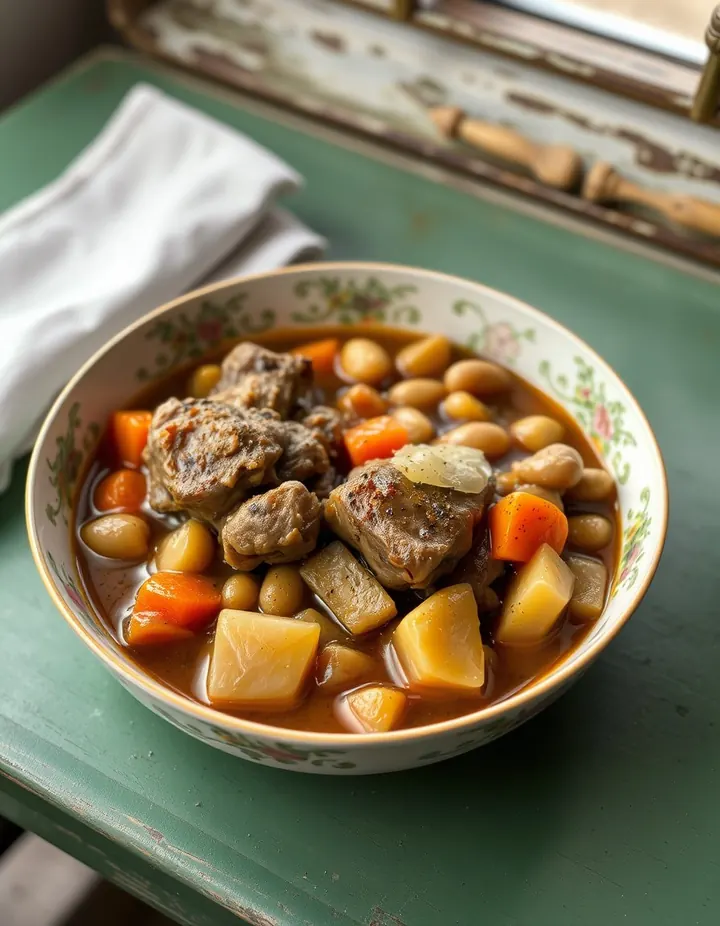
 Illustration
Why it works: Carrot and turnip are a kitchen classic. They rank in the top 2% of all ingredient pairs, and 8,001 recipes mention both. Both carry coumarin, which smells sweet, hay. The science ↓
The recipe
Ingredients
Contains: wheat (auto-detected from the ingredients and method; we can miss things, so check labels)
Also mentioned in the method: flour
Directions
Soak the haricot beans in cold water overnight in the refrigerator. In the morning, drain and rinse them.
Put the beans, sliced carrots and turnips in a pot with a pint of fresh water. Boil hard for 10 minutes, then simmer about 20 minutes in total until nearly tender. Drain, reserving the liquid.
Pat the mutton dry with paper towels; do not rinse it. Cut it into small pieces. Heat the dripping in a frying pan and fry the meat until browned. Transfer it to a saucepan.
In the same pan, fry the sliced onions until golden brown.
Stir the flour into the onions and cook for 1 minute. Gradually stir in the reserved bean liquid until smooth and thickened.
Add the beans, carrots, turnips and thickened gravy to the meat. Add a little water or stock if needed to cover, then season with salt and pepper.
Bring to a gentle simmer, not a rolling boil, and cook for about 1 hour, until the mutton is tender and reaches 145°F (63°C) in the thickest piece. Let stand 3 minutes before serving.
Cool leftovers within 2 hours and refrigerate. Eat within 3 to 4 days, or freeze for longer storage.
Reheat leftovers until steaming hot throughout, to 165°F (74°C), before serving.
Original text from the book (3 steps)
Materials. — 1 lb. breast of mutton ; haricot beans, 1 teacupful ; 2 carrots ; 2 turnips ; 2 onions ; dripping, 3 oz. ; flour, 2 tablespoonfuls ; pepper and salt.
Directions. — Wash the beans over night, and soak them in cold water till morning, then set them on to stew till needed, for they' take a long time to become soft. Wash, pare, and slice the carrots and turnips, then put them on to boil with the beans for twenty minutes in a pint of boiling water. Then cut the mutton into small pieces ; put the dripping on to heat in the frying-pan, and when quite hot, fry the meat slightly. Take it out, and place it in a saucepan ; then fry the onions brown. When the vegetables have boiled twenty minutes, strain off the water, thicken it with the flour, and fry it with the onion. Add the vegetables and thickened gravy to the meat in the saucepan, with a little more stock or water if necessary, and stew slowly, without boiling, for an hour or more.
This nice dish is something like the stewed beef which you learned to make in Lesson II., but instead of dumplings with the beef, we have haricot beans with the mutton. We have to thank the French for this, and a good many other nourishing dishes ; for they under- stand, far better than most English people, how to make a really delicious dinner without buying a whole joint of meat. Plenty of vegetables mixed with the meat, add to its good flavour, and lessen its cost. Beans and pease are of themselves so full of nourishment, that many people tell us they will take the place of meat as flesh- formers. Be that as it may, there is no doubt that we might all benefit by the teaching of vegetarians, in so far as to do with very much temeat, if we took pains to supply our families with plenty of vegetable flesh-formers.
From a scanned old cookbook. The method has been rewritten by AI to follow current food-safety guidance (safe cooking temperatures, refrigeration, no raw-egg shortcuts). It hasn't been kitchen-tested. The original text is under the method. See the original page.
Found this recipe through an AI assistant? CompKitchen also shows which ingredients go well together and why, from the aroma molecules they share and how often recipes combine them. Try the pairing tools.
The picture is an illustration, not a photo of this recipe · Contact us to use it
Explore the science
The flavor team
The pairs that carry this dish. Each one is judged two ways: how much aroma chemistry they share, and how many recipes mention both.
-
Carrot + turniptop 2% of all pairsAroma overlapmoderateMentioned together8,001 recipes
Shared aroma: coumarin (sweet, hay).
-
Carrot + oniontop 4% of all pairsAroma overlapstrongMentioned together21,599 recipes
Shared aroma: 2-isopropyl-3-methoxypyrazine (earthy, pea).
-
Turnip + oniontop 4% of all pairsAroma overlapmoderateMentioned together7,584 recipes
Shared aroma: coumarin (sweet, hay).
Ranks compare each pair with 20,000 random ingredient pairs on CompKitchen. How we score pairs
Flavor stand-ins for the onion
How well each one fits the dish's main ingredients (carrot, turnip):
- Parsnipbetter flavor fit
- Leekbetter flavor fit
- Beetrootbetter flavor fit
- Onionthe original
Fit is the average pairing score against carrot, turnip. Candidates are from the same food group and used in at least 100 recipes. This compares flavor only: it does not check the job the ingredient does in the dish (bulk, moisture, acidity, structure).
Make it your own
Stand-ins, a drink, and quick taste fixes for this dish, ranked by how well each fits its other ingredients: shared aroma molecules and how often recipes combine them.
You might also like
 Illustration
 Illustration
 Illustration
 Illustration
The Sunday pairing: one pairing, the chemistry behind it, and how to cook it. No spam, unsubscribe anytime.
Prefer an account? Create a free account for sign-in; Pro adds the full results and chemistry.