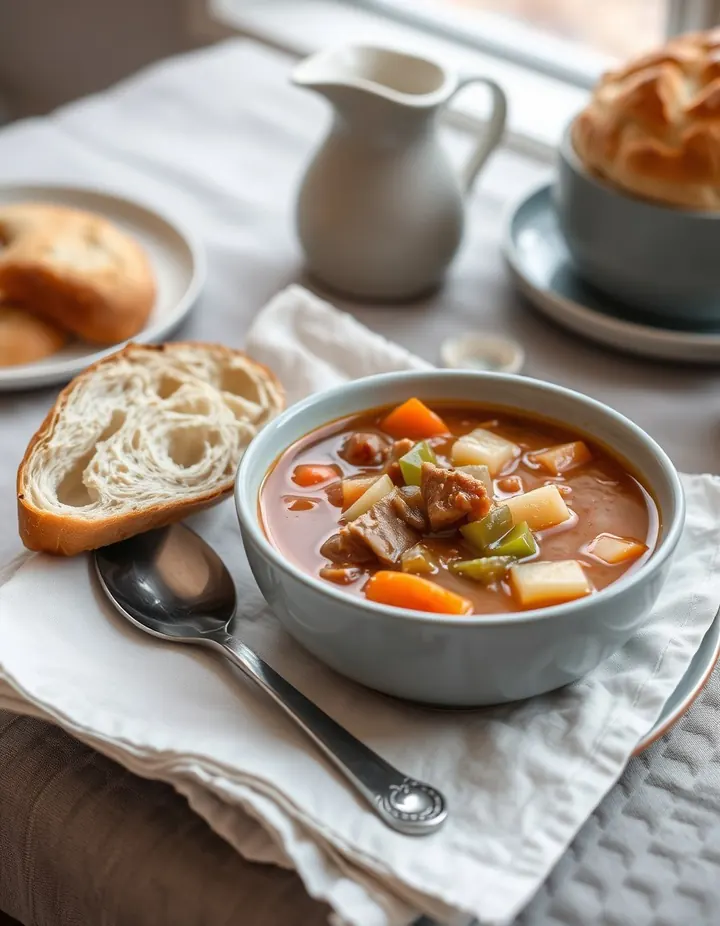
 Illustration
Why it works: Parsnip and clove match in chemistry and in kitchens. They rank in the top 6% of all ingredient pairs, and 250 recipes mention both. Both carry myrcene, which smells balsamic, herbaceous. The science ↓
The recipe
Ingredients
Contains: milk, wheat (auto-detected from the ingredients and method; we can miss things, so check labels)
Also mentioned in the method: butter, flour
Directions
Pat the ox cheek dry with paper towels; do not rinse it. Melt the butter in a large stockpot over low heat. Lay the ham slices in the bottom and set the cheek on top.
Cut the parsnip, carrots, onions and the 3 heads of celery into small pieces. Add them to the pot with the mace, cloves, bay leaf, savoury herb bundle, the salt and half as much pepper. Cook gently for 15 minutes.
Add the 6 quarts of water and bring to a bare simmer, not a boil. Simmer gently, skimming foam, for 3 to 4 hours, until about 4 quarts remain and the cheek is fork-tender.
Lift out the cheek and ham. The thickest part of the cheek must reach 145°F (63°C) on a thermometer; let it rest 3 minutes. Strain the soup into a clean pot and discard the vegetables and herbs.
Cut the cheek meat into small square pieces. Whisk the flour with a little cold soup until smooth, stir it into the strained soup, and simmer. Add the sliced head of celery and simmer until tender, about 15 minutes.
If the soup is pale, stir in a little browning. Return the meat to the soup and reheat until it reaches 165°F (74°C). Serve hot, with a piece of French roll crust in each bowl or in the tureen.
Cool leftovers within 2 hours in shallow containers and refrigerate. Eat within 3 to 4 days, or freeze for longer storage.
Original text from the book (6 steps)
For reference only, not instructions. This text may include storage, bottling, preserving or cooking steps that don't meet current food-safety guidance. Use the method above.
176. INGREDIENTS.--An ox-cheek, 2 oz. of butter, 3 or 4 slices of lean ham or bacon, 1 parsnip, 3 carrots, 2 onions, 3 heads of celery, 3 blades of mace, 4 cloves, a faggot of savoury herbs, 1 bay-leaf, a teaspoonful of salt, half that of pepper, 1 head of celery, browning, the crust of a French roll, 6 quarts of water.
_Mode_.--Lay the ham in the bottom of the stewpan, with the butter; break the bones of the cheek, wash it clean, and put it on the ham. Cut the vegetables small, add them to the other ingredients, and set the whole over a slow fire for 1/4 of an hour. Now put in the water, and simmer gently till it is reduced to 4 quarts; take out the fleshy part of the cheek, and strain the soup into a clean stewpan; thicken with flour, put in a head of sliced celery, and simmer till the celery is tender. If not a good colour, use a little browning. Cut the meat into small square pieces, pour the soup over, and serve with the crust of a French roll in the tureen. A glass of sherry much improves this soup.
_Time_.--3 to 4 hours. _Average cost_, 8d. per quart.
_Seasonable_ in winter.
_Sufficient_ for 12 persons.
THE OX.--Of the quadrupedal animals, the flesh of those that feed upon herbs is the most wholesome and nutritious for human food. In the early ages, the ox was used as a religious sacrifice, and, in the eyes of the Egyptians was deemed so sacred as to be worthy of exaltation to represent Taurus, one of the twelve signs of the zodiac. To this day, the Hindoos venerate the cow, whose flesh is forbidden to be eaten, and whose fat, supposed to have been employed to grease the cartridges of the Indian army, was one of the proximate causes of the great Sepoy rebellion of 1857. There are no animals of greater use to man than the tribe to which the ox belongs. There is hardly a part of them that does not enter into some of the arts and purposes of civilized life. Of their horns are made combs, knife-handles, boxes, spoons, and drinking-cups. They are also made into transparent plates for lanterns; an invention ascribed, in England, to King Alfred. Glue is made from their gristles, cartilages, and portions of their hides. Their bones often form a substitute for ivory; their skins, when calves, are manufactured into vellum; their blood is the basis of Prussian blue; their sinews furnish fine and strong threads, used by saddlers; their hair enters into various manufactures; their tallow is made into candles; their flesh is eaten, and the utility of the milk and cream of the cow is well known.
From a scanned old cookbook. The method has been rewritten by AI to follow current food-safety guidance (safe cooking temperatures, refrigeration, no raw-egg shortcuts). It hasn't been kitchen-tested. The original text is under the method. See the original page.
Found this recipe through an AI assistant? CompKitchen also shows which ingredients go well together and why, from the aroma molecules they share and how often recipes combine them. Try the pairing tools.
The picture is an illustration, not a photo of this recipe · Contact us to use it
Explore the science
The flavor team
The pairs that carry this dish. Each one is judged two ways: how much aroma chemistry they share, and how many recipes mention both.
-
Parsnip + clovetop 6% of all pairsAroma overlapstrongMentioned together250 recipes
Shared aroma: myrcene (balsamic, herbaceous).
-
Celery + carrottop 1% of all pairsAroma overlapstrongMentioned together10,172 recipes
Shared aroma: myristicin (spice, warm).
-
Parsnip + carrottop 1% of all pairsAroma overlapstrongMentioned together1,096 recipes
Shared aroma: 2-isopropyl-3-methoxypyrazine (earthy, pea).
-
Mace + clovetop 2% of all pairsAroma overlapmoderateMentioned together8,199 recipes
Shared aroma: methyleugenol (clove, spice).
-
Celery + parsniptop 3% of all pairsAroma overlapstrongMentioned together560 recipes
Shared aroma: myristicin (spice, warm).
Ranks compare each pair with 20,000 random ingredient pairs on CompKitchen. How we score pairs
Flavor stand-ins for the onion
How well each one fits the dish's main ingredients (ham, celery, parsnip, carrot, mace, clove):
- Turnipbetter flavor fit
- Capsicumbetter flavor fit
- Leekbetter flavor fit
- Onionthe original
Fit is the average pairing score against ham, celery, parsnip, carrot, mace, clove. Candidates are from the same food group and used in at least 100 recipes. This compares flavor only: it does not check the job the ingredient does in the dish (bulk, moisture, acidity, structure).
Make it your own
Stand-ins, a drink, and quick taste fixes for this dish, ranked by how well each fits its other ingredients: shared aroma molecules and how often recipes combine them.
You might also like
 Illustration
 Illustration
 Illustration
 Illustration
The Sunday pairing: one pairing, the chemistry behind it, and how to cook it. No spam, unsubscribe anytime.
Prefer an account? Create a free account for sign-in; Pro adds the full results and chemistry.