Aroma molecule · ketone
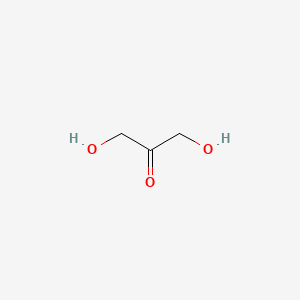
dihydroxyacetone
Smells ofattractant to slugs
Found in 345 ingredients. We hold no measured concentration for it in any of them yet, so we cannot say where it is strong enough to smell.
Working on a formulation or a product line? This compound data is available by API for R&D teams.
01How little it takes
No published odour threshold on file for dihydroxyacetone.
02Where it turns up
- Fruit95
- Herbs & spices62
- Grains, nuts & fats57
- Vegetables55
- Meat & fish11
- Drinks4
- Dairy1
- Other60
of the 345 ingredients that contain it, by food group
03What it travels with
line weight = ingredients carrying both, of 345 · only molecules found with it at least 1.5× as often as across all foods
What does dihydroxyacetone smell like?
Sources describe it as attractant to slugs.
Which foods contain dihydroxyacetone?
We list 345 ingredients that contain it, but presence is not the same as smell. What matters is how much is there compared with how little it takes to notice it. That ratio is the odour activity value (OAV). Above 1 suggests it may be noticeable; it is a screening indicator, not a guarantee.
Found in
Measured foods first, then real food profiles, then thin or composite records (marked). The figure beside each is how many compounds that ingredient has in total, not the amount of dihydroxyacetone in it. ✓n = sources that recorded the link.
How strong is dihydroxyacetone?
We hold no published odour threshold for dihydroxyacetone, so we cannot say how little of it you could smell.
- Volatility
- high
What is it found with?
Of the 345 ingredients that carry dihydroxyacetone, 345 also carry 1,2-benzenediol, 345 2,3-butanedione and 345 2-methyl-1-butanol. These are the most frequent companions among molecules that turn up with dihydroxyacetone at least 1.5 times as often as they do across all foods; the very common molecules found nearly everywhere are left out because they say nothing about it.
Is dihydroxyacetone safe to eat?
Dihydroxyacetone is listed by FEMA as generally recognized as safe (GRAS) for use as a flavoring: FEMA number 4033, published in GRAS 21. Check current FDA and EFSA guidance for your market and use level.
- FEMA number
- 4033 ✓ exact match
- Publication
- GRAS 21
- FEMA name
- DIHYDROXYACETONE
Use-level matrix not extracted for this substance; check the source publication for current ppm guidance.
Source: FEMA GRAS publications 1–33.
See all 345 ingredients with Pro
The free page shows the first 8. The inverted compound index is a Pro feature: reverse-search any of 5,133 flavor molecules across the full graph.
Look up another compound — search by name, CAS number, PubChem CID, or FEMA #.
The Sunday pairing: one pairing, the chemistry behind it, and how to cook it. No spam, unsubscribe anytime.
Prefer an account? Create a free account for sign-in; Pro adds the full results and chemistry.
Try the pairing tools to see which ingredient combinations rely on dihydroxyacetone, or compare two ingredients side by side.
Cite this analysis
CompKitchen (2026). dihydroxyacetone compound data sheet. https://compkitchen.com/compound/dihydroxyacetone. Accessed 2026-11-23.
@misc{compkitchen_compound_dihydroxyacetone_compound_data_sheet_2026,
  title  = {dihydroxyacetone compound data sheet},
  author = {{CompKitchen}},
  year   = {2026},
  url    = {https://compkitchen.com/compound/dihydroxyacetone},
  note   = {Accessed: 2026-11-23}
}
Methodology DOI: 10.5281/zenodo.19719458 · CC BY 4.0 · Citations are a request, not a requirement.