Aroma molecule · terpenoid
neophytadiene
Smells ofvolatile attractant
Found in 6 ingredients; measured in 1 of them and below the smell threshold in every one.
Working on a formulation or a product line? This compound data is available by API for R&D teams.
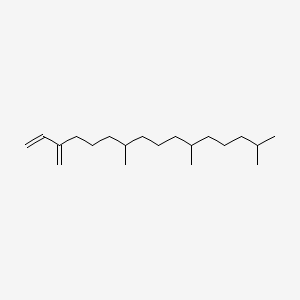
- Formula
- C20H38
- Mass
- 278.5 g/mol
- CAS
- 504-96-1
- PubChem
- 10446
- FEMA
- not listed
- Threshold · working value
- 89.5 ppb
- Class
- terpenoid
- Status
- Aroma-active
Where you’d actually smell it
Each food placed by its measured amount of neophytadiene divided by the smallest amount people can smell (89.5 ppb, our working threshold). Past 1× it may be noticeable; this is a screening indicator, since the food’s matrix and its other aromas shift what you actually smell. One of the foods we list has a measured value.
Scroll sideways to see the whole ruler →
Only foods we hold neophytadiene in and have a measured concentration for are placed. Every measured row, with its source, is in the table below.
01How little it takes
No published odour threshold on file for neophytadiene.
02Where it turns up
- Meat & fish2
- Vegetables1
- Herbs & spices1
- Other2
of the 6 ingredients that contain it, by food group
03What it travels with
line weight = ingredients carrying both, of 6 · only molecules found with it at least 1.5× as often as across all foods
What does neophytadiene smell like?
Sources describe it as volatile attractant.
Which foods contain neophytadiene?
We list 6 ingredients that contain it, but presence is not the same as smell. What matters is how much is there compared with how little it takes to notice it. That ratio is the odour activity value (OAV). Above 1 suggests it may be noticeable; it is a screening indicator, not a guarantee.
- Present but below the threshold: tomato.
Found in
Measured foods first, then real food profiles, then thin or composite records (marked). The figure beside each is how many compounds that ingredient has in total, not the amount of neophytadiene in it. ✓n = sources that recorded the link.
- tomato measured · 0.68× threshold 510 cmpds
- tobacco plant 144 cmpds
- lamb meat 261 cmpds
- dill herb ✓2 342 cmpds
- beef meat ✓1 429 cmpds
- tea plant 578 cmpds
Measured concentrations
| Food | Concentration (ppb) | OAV | Source |
|---|---|---|---|
| tomato | 61.0 | 0.68 | — |
| rum | 19.9 | 0.22 | — |
OAV = measured concentration ÷ odour threshold (89.5 ppb). OAV ≥ 1 suggests it may be perceptible; treat it as a screening indicator. Concentrations from open-access papers; a row whose food is not one of the ingredients above is listed here but not placed on the ruler.
How strong is neophytadiene?
Our working odour threshold is 89.5 ppb.
Thresholds in published tables
| Medium | Median | Range | Values | Papers | Papers agree? |
|---|---|---|---|---|---|
| unstated | 30 ppb | 30–30 | 1 | 1 | one paper |
Numbers printed in open-access papers, grouped by the medium the table states. Median and full range; “agree” means two or more papers whose middle 80% of values sit within 100×. Not reviewed.
- Volatility
- low
- Retention index
- 1837
What is it found with?
Of the 6 ingredients that carry neophytadiene, 6 also carry acetaldehyde, 6 benzaldehyde and 6 butanal. These are the most frequent companions among molecules that turn up with neophytadiene at least 1.5 times as often as they do across all foods; the very common molecules found nearly everywhere are left out because they say nothing about it.
Is neophytadiene safe to eat?
Not in FEMA GRAS publications 1–33. Of 3,367 listed flavoring substances, none match this compound or its other names. It may still be food-safe under other regulatory routes (FDA 21 CFR 172, EFSA, JECFA); check femaflavor.org for the authoritative current list.
Look up another compound — search by name, CAS number, PubChem CID, or FEMA #.
The Sunday pairing: one pairing, the chemistry behind it, and how to cook it. No spam, unsubscribe anytime.
Prefer an account? Create a free account for sign-in; Pro adds the full results and chemistry.
Try the pairing tools to see which ingredient combinations rely on neophytadiene, or compare two ingredients side by side.
Cite this analysis
CompKitchen (2026). neophytadiene compound data sheet. https://compkitchen.com/compound/neophytadiene. Accessed 2026-11-24.
@misc{compkitchen_compound_neophytadiene_compound_data_sheet_2026,
  title  = {neophytadiene compound data sheet},
  author = {{CompKitchen}},
  year   = {2026},
  url    = {https://compkitchen.com/compound/neophytadiene},
  note   = {Accessed: 2026-11-24}
}
Methodology DOI: 10.5281/zenodo.19719458 · CC BY 4.0 · Citations are a request, not a requirement.