Why it works: Ginger and mustard are a kitchen classic. They rank in the top 7% of all ingredient pairs, and 2,456 recipes mention both. Both carry 2-isopropyl-3-methoxypyrazine, which smells earthy, pea. The science ↓
The recipe
Ingredients
Directions
Prepare the carrots
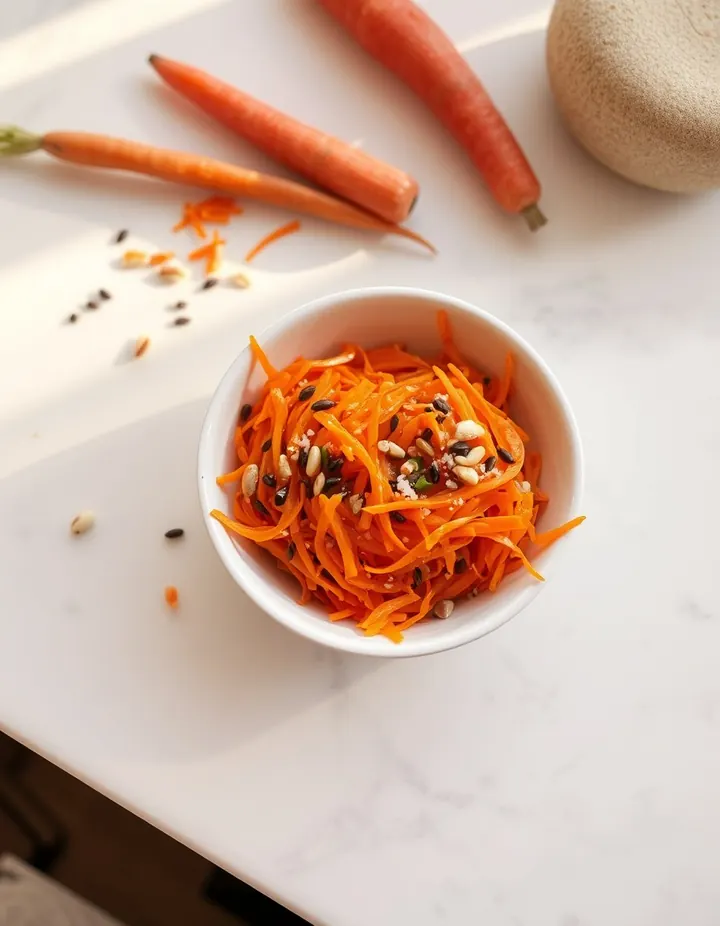
Peel and trim carrots and cut into matchsticks.
Bring water to a boil in a vegetable steamer then add carrots.
Cover and steam for 7 minutes.
Remove from steamer and immediately run under cold water to stop further cooking.
Drain and dry thoroughly on paper towels then set aside.
Make the dressing
In a medium salad bowl combine vinegar, lemon juice, ginger, sugar and mustard then whisk until the sugar has dissolved.
Add olive oil in a slow steady stream whisking constantly until vinaigrette is well blended and creamy.
Add cilantro then season with salt and pepper.
Assemble and chill
Add carrots and toss to coat evenly.
Cover and refrigerate 4 to 6 hours.
Thirty minutes before serving, bring the salad back to room temperature.
Garnish with cilantro.
This recipe comes from the Recipes Wiki on Fandom and is licensed CC BY-SA 4.0. Our formatting and summaries are shared under the same licence.
Steps grouped into stages for easier reading; the method is the source's own.
Found this recipe through an AI assistant? CompKitchen also shows which ingredients go well together and why, from the aroma molecules they share and how often recipes combine them. Try the pairing tools.
Explore the science
The flavor team
The pairs that carry this dish. Each one is judged two ways: how much aroma chemistry they share, and how many recipes mention both.
-
Ginger + mustardtop 7% of all pairsAroma overlapmoderateMentioned together2,456 recipes
Shared aroma: 2-isopropyl-3-methoxypyrazine (earthy, pea).
-
Carrot + gingertop 2% of all pairsAroma overlapstrongMentioned together1,377 recipes
Shared aroma: 2-isopropyl-3-methoxypyrazine (earthy, pea).
-
Lemon + gingertop 3% of all pairsAroma overlapstrongMentioned together5,154 recipes
Shared aroma: beta-phellandrene (minty, terpene).
-
Vinegar + mustardtop 4% of all pairsAroma overlaplowMentioned together14,067 recipes
Shared aroma: isobutyraldehyde (malty, green).
-
Ginger + garlictop 4% of all pairsAroma overlapmoderateMentioned together6,402 recipes
Shared aroma: beta-phellandrene (minty, terpene).
Vinegar and mustard share little aroma chemistry, yet 14,067 recipes mention both: they likely work on texture and structure more than aroma.
Ranks compare each pair with 20,000 random ingredient pairs on CompKitchen. How we score pairs
What each ingredient does
- Carrots
- Provide the main body and crisp-tender bite of the salad.
- Olive oil
- Adds fat and richness, and emulsifies with the mustard into a creamy dressing.
- Spicy mustard
- Acts as an emulsifier that helps hold the oil and vinegar together.
- Cider vinegar
- Adds acidity that brightens the dressing and balances the oil.
- Lemon juice
- Adds fresh acidity and brightness to the vinaigrette.
- Granulated sugar
- Adds sweetness that softens the sharpness of the vinegar and lemon.
The step that matters
Adding the olive oil slowly while whisking. Oil added in a slow, steady stream and whisked constantly forms a stable emulsion with the vinegar, lemon juice and mustard. Dumping it in at once lets the oil separate, leaving a greasy, unevenly blended dressing instead of a creamy one.
Flavor stand-ins for the garlic
How well each one fits the dish's main ingredients (carrot, cider, vinegar, lemon, ginger, sugar, mustard):
- Cinnamonbetter flavor fit
- Allspicebetter flavor fit
- Cardamombetter flavor fit
- Garlicthe original
Fit is the average pairing score against carrot, cider, vinegar, lemon, ginger, sugar, mustard. Candidates are from the same food group and used in at least 100 recipes. This compares flavor only: it does not check the job the ingredient does in the dish (bulk, moisture, acidity, structure).
“What each ingredient does” and “The step that matters” were written by Claude, an AI, from this recipe’s own method. They are not checked recipe by recipe, so they can be wrong.
Make it your own
Stand-ins, a drink, and quick taste fixes for this dish, ranked by how well each fits its other ingredients: shared aroma molecules and how often recipes combine them.
You might also like
 Illustration
 Illustration
 Illustration
 Illustration
The Sunday pairing: one pairing, the chemistry behind it, and how to cook it. No spam, unsubscribe anytime.
Prefer an account? Create a free account for sign-in; Pro adds the full results and chemistry.