 Illustration
Why it works: Wheat and milk match in chemistry and in kitchens. They rank in the top 3% of all ingredient pairs, and 2,416 recipes mention both. Both carry hexanal, which smells green, grassy. The science ↓
The recipe
Ingredients
Contains: egg, milk, wheat (auto-detected from the ingredients and method; we can miss things, so check labels)
Directions
Make the sponge
Dissolve a half cake of compressed yeast in half a pint of milk, and add sufficient quantity of rich milk to make a pint.
Stir into it three cups of whole wheat flour, and set in a warm place to rise.
When light, stir in two well-beaten eggs, and turn into gem irons, half folding them.
Bake the muffins
Let them rise until very light, and bake in a quick oven.
Bake for five minutes after the top has blistered.
Make the rusk dough
Combine one pint of milk, half a cup of melted butter, two beaten eggs, one cup powdered sugar, one quart of flour, half a cake of compressed yeast melted in luke-warm water, or one half a cup of other good yeast.
Mix well; set it away to rise.
When risen to twice its original size, knead well, adding more flour if necessary, make into rusk, put into a pan to rise again.
When quite light, bake in a moderate warm oven about three-quarters of an hour.
Make the griddle rings
Make the milk warm, and stir it into the yeast with a little salt.
Add a sufficient quantity of flour to make it into a batter.
Set it to rise for half an hour, then add a cupful of melted butter.
Stir it well in, and pour it into iron rings, previously placed on hot griddle, and bake them very lightly on both sides.
When required toast them on both sides, taking care they do not burn.
Butter them nicely, cut them across, and put them up on a hot plate.
Serve them quickly; hot.
Transcribed from a scanned cookbook and modernised for today's kitchens. Where the book gave no heat or time, or said "a moderate oven", the temperatures and times here may be modern equivalents rather than the book's own figures. See the original page.
Found this recipe through an AI assistant? CompKitchen also shows which ingredients go well together and why, from the aroma molecules they share and how often recipes combine them. Try the pairing tools.
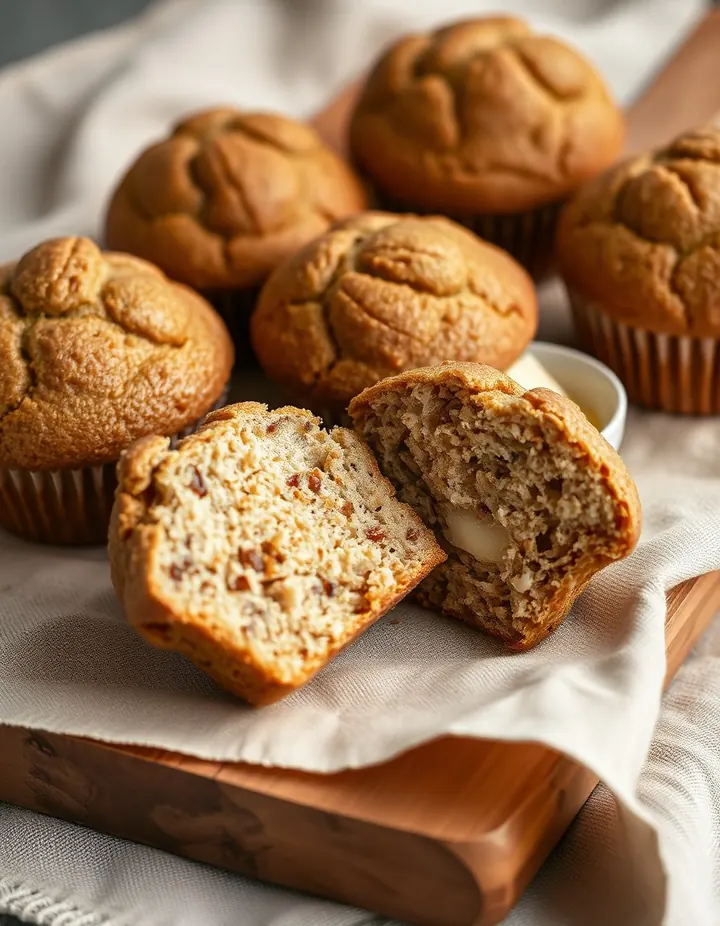
The picture is an illustration, not a photo of this recipe · Contact us to use it
Explore the science
The flavor team
The pairs that carry this dish. Each one is judged two ways: how much aroma chemistry they share, and how many recipes mention both.
-
Wheat + milktop 3% of all pairsAroma overlapstrongMentioned together2,416 recipes
Shared aroma: hexanal (green, grassy).
-
Milk + buttertop 3% of all pairsAroma overlapstrongMentioned together81,222 recipes
Shared aroma: (z)-4-heptenal (biscuit, cream).
-
Wheat + buttertop 6% of all pairsAroma overlapstrongMentioned together1,999 recipes
Shared aroma: (z)-4-heptenal (biscuit, cream).
-
Flour + buttertop 6% of all pairsAroma overlaplowMentioned together122,858 recipes
Shared aroma: isobutyraldehyde (malty, green).
-
Wheat + flourtop 7% of all pairsAroma overlaplowMentioned together4,327 recipes
Shared aroma: isobutyraldehyde (malty, green).
Flour and butter share little aroma chemistry, yet 122,858 recipes mention both: they likely work on texture and structure more than aroma.
Ranks compare each pair with 20,000 random ingredient pairs on CompKitchen. How we score pairs
What each ingredient does
- Compressed yeast
- Leavens the batter and dough so they rise and become light.
- Whole wheat flour
- Provides the structure of the batter and dough.
- Eggs
- Add richness and help bind the batter for a tender crumb.
- Melted butter
- Adds fat for tenderness and richness.
- Milk
- Adds moisture and hydrates the flour so the dough can develop.
- Powdered sugar
- Adds sweetness and helps the dough brown in the oven.
The step that matters
Letting the dough rise fully before baking. Yeast needs time to produce gas and stretch the gluten; baking too early gives dense, heavy muffins, while the rise must be completed before the oven does its work.
“What each ingredient does” and “The step that matters” were written by Claude, an AI, from this recipe’s own method. They are not checked recipe by recipe, so they can be wrong.
Make it your own
Stand-ins, a drink, and quick taste fixes for this dish, ranked by how well each fits its other ingredients: shared aroma molecules and how often recipes combine them.
You might also like
 Illustration
 Illustration
 Illustration
 Illustration
The Sunday pairing: one pairing, the chemistry behind it, and how to cook it. No spam, unsubscribe anytime.
Prefer an account? Create a free account for sign-in; Pro adds the full results and chemistry.