The recipe
Ingredients
Contains: milk, wheat (auto-detected from the ingredients and method; we can miss things, so check labels)
Also mentioned in the method: butter, flour
Directions
Make the stock
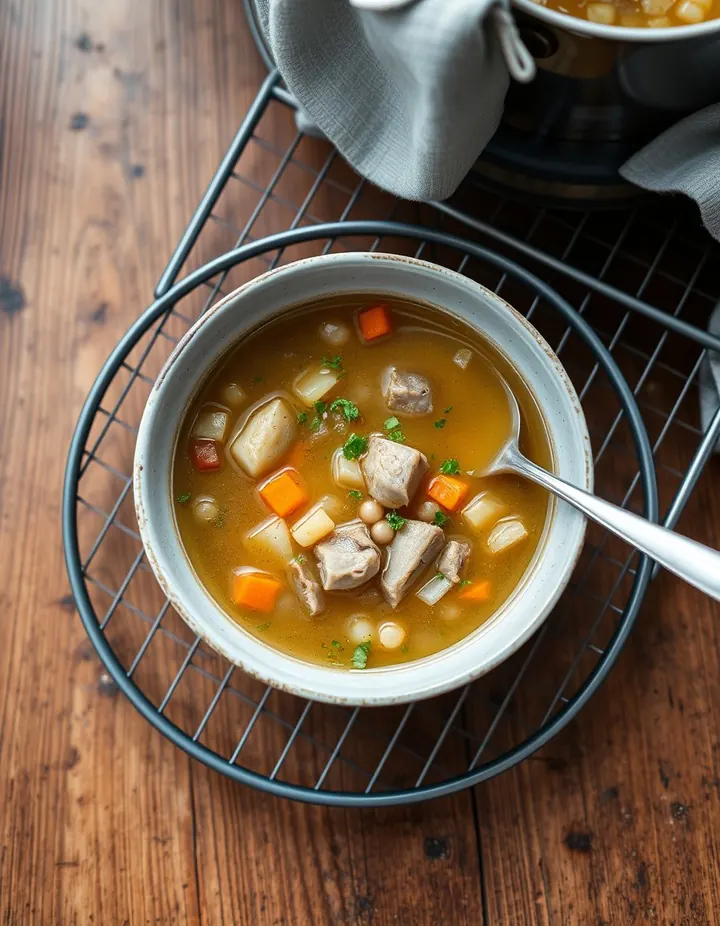
Cook an old fowl jointed 5 or 6 hours in a gallon of unsalted water.
When liquid is reduced, set aside with the fowl until the next day.
Skim off fat and strain out the meat.
Finish the gumbo
Season the stock with a large grated onion, pepper, and salt; add a can of tomatoes, chopped finely, and 3 dozen pods of okra cut into one-quarter inch bits, with a tablespoon of butter rubbed up with flour.
Cook for three-quarters of an hour.
Transcribed from a scanned cookbook and modernised for today's kitchens. Where the book gave no heat or time, or said "a moderate oven", the temperatures and times here may be modern equivalents rather than the book's own figures. See the original page.
Found this recipe through an AI assistant? CompKitchen also shows which ingredients go well together and why, from the aroma molecules they share and how often recipes combine them. Try the pairing tools.
Explore the science
What each ingredient does
- Okra
- Releases mucilage that thickens the broth and gives gumbo its characteristic body.
- Butter rubbed with flour (in the method)
- Forms a roux-like paste that thickens the stock and adds richness.
- Tomatoes (in the method)
- Add acidity and body to the broth, balancing the richness of the fowl and fat.
- Fowl (in the method)
- Long simmering breaks down connective tissue and releases gelatin and flavor into the stock.
The step that matters
Skim off fat and strain out the meat. Fat left in the stock turns the gumbo greasy and muddies its flavor, so removing it after the stock has cooled and set helps produce a clean, rich broth.
“What each ingredient does” and “The step that matters” were written by Claude, an AI, from this recipe’s own method. They are not checked recipe by recipe, so they can be wrong.
Make it your own
Stand-ins, a drink, and quick taste fixes for this dish, ranked by how well each fits its other ingredients: shared aroma molecules and how often recipes combine them.
You might also like
 Illustration
 Illustration
 Illustration
 Illustration
The Sunday pairing: one pairing, the chemistry behind it, and how to cook it. No spam, unsubscribe anytime.
Prefer an account? Create a free account for sign-in; Pro adds the full results and chemistry.