Why it works: Cabbage and vinegar are a kitchen classic. They rank in the top 6% of all ingredient pairs, and 2,924 recipes mention both. Both carry 4'-methylacetophenone, which smells bitter almond. The science ↓
The recipe
Ingredients
Contains: milk (auto-detected from the ingredients and method; we can miss things, so check labels)
Directions
Prepare the cabbage
Preheat oven to 325 degrees.
Wash cabbage and remove outer leaves.
Cut cabbage in half lengthwise, remove core, and slice or chop finely.
Braise
Combine butter, sugar, salt, water, and vinegar in a heavy 4- or 5-quart casserole and bring the mixture to a boil on the stove.
Add cabbage to the boiling mixture and toss well to coat.
Bring the mixture to a boil again.
Cover the casserole and place it in the oven.
Bake for 2 hours, checking the casserole occasionally and adding water if all liquid has cooked away.
Ten minutes before cooking is finished, stir in red currant jelly and grated apples and replace the cover.
This recipe comes from the Recipes Wiki on Fandom and is licensed CC BY-SA 4.0. Our formatting and summaries are shared under the same licence.
Steps grouped into stages for easier reading; the method is the source's own.
Found this recipe through an AI assistant? CompKitchen also shows which ingredients go well together and why, from the aroma molecules they share and how often recipes combine them. Try the pairing tools.
Explore the science
The flavor team
The pairs that carry this dish. Each one is judged two ways: how much aroma chemistry they share, and how many recipes mention both.
-
Cabbage + vinegartop 6% of all pairsAroma overlapmoderateMentioned together2,924 recipes
Shared aroma: 4'-methylacetophenone (bitter almond).
-
Red currant + appletop 6% of all pairsAroma overlapmoderateMentioned together110 recipes
Shared aroma: isoamyl acetate (banana, pear).
-
Butter + appletop 6% of all pairsAroma overlapstrongMentioned together8,692 recipes
Shared aroma: gamma-undecalactone (peach, sweet).
-
Cabbage + appletop 6% of all pairsAroma overlapstrongMentioned together224 recipes
Shared aroma: 2-isopropyl-3-methoxypyrazine (earthy, pea).
-
Vinegar + red curranttop 7% of all pairsAroma overlapmoderateMentioned together188 recipes
Shared aroma: isoamyl acetate (banana, pear).
Ranks compare each pair with 20,000 random ingredient pairs on CompKitchen. How we score pairs
What each ingredient does
- Red cabbage
- Forms the bulk of the dish and becomes tender during long, moist braising.
- Butter
- Adds richness and a silky mouthfeel to the braising liquid.
- Vinegar
- Adds acidity that brightens the flavor and helps the cabbage keep its red color.
- Sugar
- Balances the sharpness of the vinegar and rounds out the flavor.
- Red currant jelly
- Adds sweetness, fruity depth, and gentle body to the sauce.
- Grated apples
- Add natural sweetness and pectin that help thicken the braising liquid.
The step that matters
Adding the jelly and apples near the end. Jelly and apples contain sugars that can scorch on the bottom of the casserole if cooked too long without enough liquid. Adding them ten minutes before finishing keeps them from burning while still blending their flavor into the sauce.
Flavor stand-ins for the red currant
How well each one fits the dish's main ingredients (cabbage, butter, sugar, vinegar, apple):
- Grapebetter flavor fit
- Plumbetter flavor fit
- Pearbetter flavor fit
- Red currantthe original
Fit is the average pairing score against cabbage, butter, sugar, vinegar, apple. Candidates are from the same food group and used in at least 100 recipes. This compares flavor only: it does not check the job the ingredient does in the dish (bulk, moisture, acidity, structure).
“What each ingredient does” and “The step that matters” were written by Claude, an AI, from this recipe’s own method. They are not checked recipe by recipe, so they can be wrong.
Make it your own
Stand-ins, a drink, and quick taste fixes for this dish, ranked by how well each fits its other ingredients: shared aroma molecules and how often recipes combine them.
You might also like
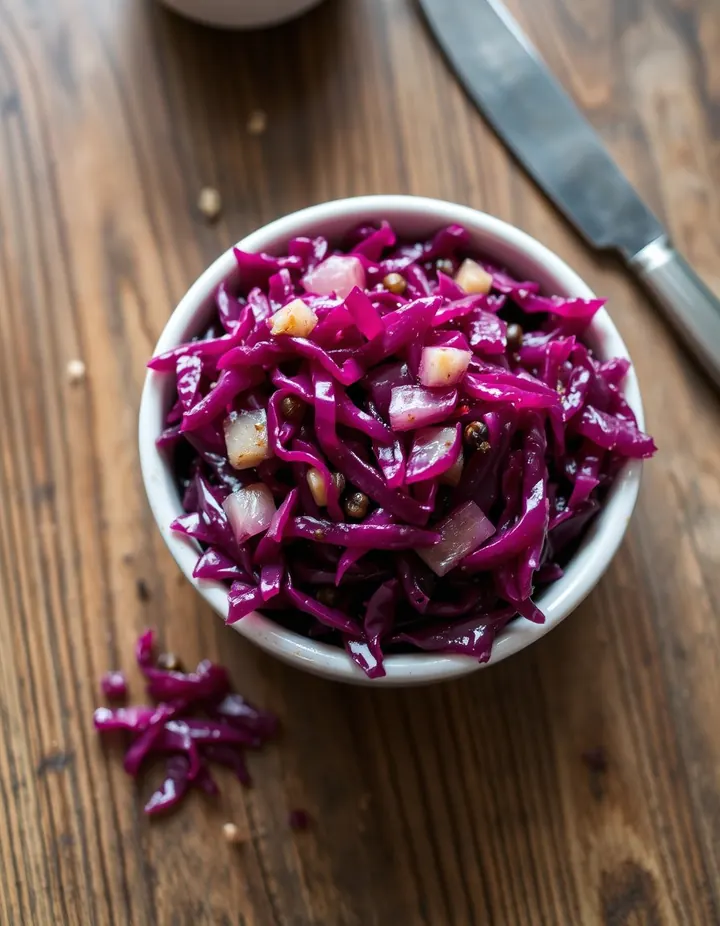 Illustration
 Illustration
 Illustration
 Illustration
The Sunday pairing: one pairing, the chemistry behind it, and how to cook it. No spam, unsubscribe anytime.
Prefer an account? Create a free account for sign-in; Pro adds the full results and chemistry.