Why it works: Rye and buckwheat share more aroma than cooks usually use. They rank in the top 3% of all ingredient pairs, and 22 recipes mention both. Both carry coumarin, which smells sweet, hay. The science ↓
The recipe
Ingredients
Contains: egg, milk, wheat (auto-detected from the ingredients and method; we can miss things, so check labels)
Directions
Put the butter in a pitcher, pour over half a pint of boiling water, and stir until melted. Stir in the pint of milk and let the mixture cool to lukewarm, about 100°F (38°C), not hot.
In a large bowl, mix the three pints of flour, the two large spoonfuls of yeast and the half teaspoonful of salt. Pour in the liquid and mix to a soft dough.
Cover and let the dough rise at room temperature until doubled, about 8 hours or overnight. You may refrigerate it overnight instead, then let it come to room temperature before shaping.
Turn the dough onto a floured board and knead well by hand for about 5 minutes, scraping the sides of the bowl clean, until smooth. Roll it 1 inch (2.5 cm) thick.
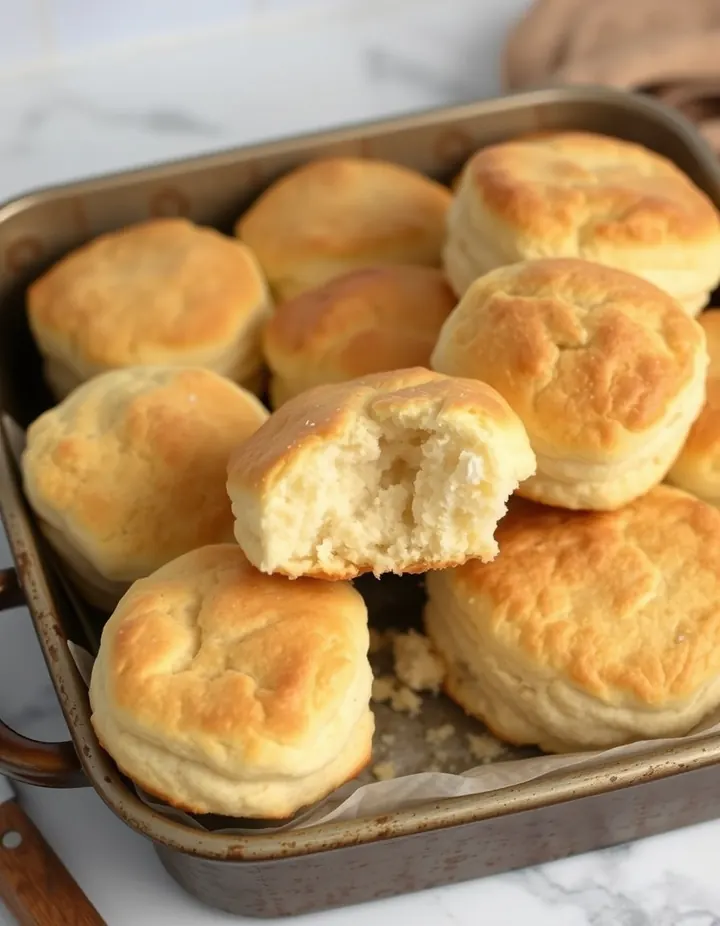
Cut rounds with a biscuit cutter. Butter your pans, place the biscuits in them, cover, and let them rise for 20 to 30 minutes until puffy.
Bake at 400°F (205°C) for 20 to 25 minutes, until golden brown and hollow-sounding when tapped. The centre should reach about 190°F (88°C).
Cool on a rack. Store wrapped at room temperature and eat within 2 days, or freeze for longer keeping.
Original text from the book (12 steps)
One pint of rye meal, one pint of Indian meal, one pint of wheat flour, half a cup of yeast; mix it up with warm water into a stiflf dough; set it to rise eight hours. Bake
PEIMARY COOK BOOK. 37
it either in loaves or biscuit. Wet the hands in cold water to put it into pans. Bake it in a hot oven forty minutest
Put a piece of butter half the size of an egg into a pitcher, turn in half a pint of boiling water, stir it until the butter is melted, cool it with a pint of milk; take three pints of flour, two large spoonfuls of yeast, half a teaspoonful of salt, mix them togethef nicely, and set it to rise. The next morning knead it .up well with the hands, be sure and get it all off the sides of the pan ; put it on td the bread-board and roll it an inch thick, cut it with the biscuit- cutter. Butter your pans, put in your bis- cuit. Let them bake twenty-five minutes.
For a small family I think it may be about as cheap to buy bread, unless you like stale bread, for you need so little. If you make your bread, bake it when your
38 MRS. PUTNAJM'S
fire is good and you are doing other things ; to make a fire to bake your little loaf would cost more than to buy it. One loaf of brown bread would be enough for three breakfasts ; the first morning hot, the next toast, and the next brewis.
To make brewis, take the crusts of brown or white bread; break them up in small pieces, put them into a saucepan, with a little salt and butter and a cup of milk, let this soak over night. In the morning let it boil about ten minutes.
BUCKWHEAT CAKES
Take one pint of buckwheat, half a tea- cup of fine Indian meal, a teaspoonful of salt, half a gill of good yeast; mix them with warm water enough to make a batter, not very thick, stirring it well. It is best to mix it in a pitcher ; set it in a warm place to rise till the next morning. Then rub the griddle well with a clean coarse
• PRIMARY COOK BOOK. 39
dish-cloth ; let it get quite hot, have a piece of pork ready, about two inches square, with a fork in it firm; rub the griddle over with the pork ; stir up the batter, turn it on in the form of a cake, the size of a small saucer. It takes five minutes to fry them. You will see, as they begin to fry, little holes all over them, as soon as the edges look a little brown, turn them with a broad knife.
From a scanned old cookbook. The method has been rewritten by AI to follow current food-safety guidance (safe cooking temperatures, refrigeration, no raw-egg shortcuts). It hasn't been kitchen-tested. The original text is under the method. See the original page.
Found this recipe through an AI assistant? CompKitchen also shows which ingredients go well together and why, from the aroma molecules they share and how often recipes combine them. Try the pairing tools.
Explore the science
The flavor team
The pairs that carry this dish. Each one is judged two ways: how much aroma chemistry they share, and how many recipes mention both.
-
Rye + buckwheattop 3% of all pairsAroma overlapstrongMentioned together22 recipes
Shared aroma: coumarin (sweet, hay).
-
Rye + wheattop 2% of all pairsAroma overlapstrongMentioned together404 recipes
Shared aroma: coumarin (sweet, hay).
-
Wheat + buckwheattop 3% of all pairsAroma overlapstrongMentioned together113 recipes
Shared aroma: myrcene (balsamic, herbaceous).
-
Butter + breadtop 3% of all pairsAroma overlapstrongMentioned together27,145 recipes
Shared aroma: delta-decalactone (sweet, creamy).
-
Wheat + milktop 3% of all pairsAroma overlapstrongMentioned together2,416 recipes
Shared aroma: hexanal (green, grassy).
Ranks compare each pair with 20,000 random ingredient pairs on CompKitchen. How we score pairs
Make it your own
Stand-ins, a drink, and quick taste fixes for this dish, ranked by how well each fits its other ingredients: shared aroma molecules and how often recipes combine them.
More bread recipes
You might also like
 Illustration
 Illustration
 Illustration
 Illustration
The Sunday pairing: one pairing, the chemistry behind it, and how to cook it. No spam, unsubscribe anytime.
Prefer an account? Create a free account for sign-in; Pro adds the full results and chemistry.