Aroma molecule · phenol
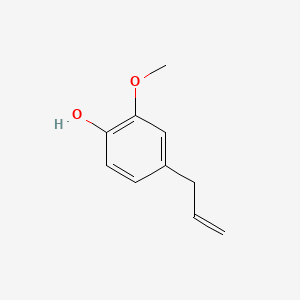
eugenol
Smells ofclove, spicy, woody, sweet
Found in 435 ingredients; measured in 18 of them and clearly above the level you can smell in fennel, vanilla, liver and orange and 9 more.
Working on a formulation or a product line? This compound data is available by API for R&D teams.
Where you’d actually smell it
Each food placed by its measured amount of eugenol divided by the smallest amount people can smell (12.55 ppb, our working threshold). Past 1× it may be noticeable; this is a screening indicator, since the food’s matrix and its other aromas shift what you actually smell. 18 of the foods we list have a measured value; 17 are above the line.
Scroll sideways to see the whole ruler →
Only foods we hold eugenol in and have a measured concentration for are placed. * Unreviewed: nutmeg is a single bulk-extracted value far above every other food, plotted but not used in the summary until it is checked against its paper. Every measured row, with its source, is in the table below.
01How little it takes
- in water 2.24
- in a food 6
- in alcohol 10.7
- in wine/beer 6
Parts per billion (ppb), log scale · tick = median of published values, bar = full range, from open-access paper tables (not reviewed)
02Where it turns up
- Fruit99
- Herbs & spices71
- Grains, nuts & fats61
- Vegetables58
- Drinks30
- Meat & fish21
- Dairy1
- Other94
of the 435 ingredients that contain it, by food group
03What it travels with
line weight = ingredients carrying both, of 435 · only molecules found with it at least 1.5× as often as across all foods
What does eugenol smell like?
Sources describe it as clove, spicy, woody, sweet. The key-food-odorant survey gives clove-like.
It is a key food odorant (intermediary): identified in the meta-analysis of 227 food samples as one of 57 intermediary odorants, which appear in 5–25% of foods. Source: Dunkel et al. 2014, Angew. Chem. Int. Ed. 53, 7124–7143
How this molecule is described
Also filed as: 4-allyl-2-methoxyphenol — same molecule, unified here.
- clove, honey, spicy Flavornet Cas, Flavornet Name, Flavordb Odor Column 3 sources agree
- menthol, chemical FlavorDB 2.0, Flavordb Odor Column 2 sources agree
- apple, pepper FlavorDB 2.0, Flavordb Odor Column 2 sources agree
- fermented, clove FlavorDB 2.0, Flavordb Odor Column 2 sources agree
- rose FlavorDB 2.0, Flavordb Odor Column 2 sources agree
- cinnamon FlavorDB 2.0, Flavordb Odor Column 2 sources agree
About these descriptions
Ordered by how many independent descriptor streams give each wording, then by how often it appears. The bar is replication (one source copied onto many ingredients scores high), not corroboration.Which foods contain eugenol?
We list 435 ingredients that contain it, but presence is not the same as smell. What matters is how much is there compared with how little it takes to notice it. That ratio is the odour activity value (OAV). Above 1 suggests it may be noticeable; it is a screening indicator, not a guarantee.
- Clearly there (10× or more): fennel, vanilla, liver, orange, melon, banana, pepper, wine, tea, peach, blueberry, grape, honey.
- Faint (1–10×): tomato, rice, rum.
- Present but below the threshold: red wine.
Found in
Measured foods first, then real food profiles, then thin or composite records (marked). The figure beside each is how many compounds that ingredient has in total, not the amount of eugenol in it. ✓n = sources that recorded the link.
- nutmeg measured · 79,681× threshold ✓2 301 cmpds
- fennel measured · 7,968× threshold ✓2 303 cmpds
- vanilla measured · 4,781× threshold ✓1 305 cmpds
- liver measured · 1,275× threshold 268 cmpds
- orange measured · 527× threshold 466 cmpds
- melon measured · 159× threshold 407 cmpds
- banana measured · 108× threshold ✓2 357 cmpds
- pepper measured · 86× threshold ✓2 460 cmpds
Measured concentrations
| Food | Concentration (ppb) | OAV | Source |
|---|---|---|---|
| nutmeg | 1,000,000.0 | 79,681 | — |
| watermelon | 750,000.0 | 59,761 | — |
| fennel | 100,000.0 | 7,968 | PMID 39577927 |
| vanilla | 60,000.5 | 4,781 | PMID 37543600 |
| rainbow trout | 20,000.0 | 1,594 | PMID 38811794 |
| liver | 16,000.0 | 1,275 | PMID 41047379 |
| orange | 6,610.0 | 527 | DOI |
| melon | 2,000.0 | 159 | PMC12146550 |
| bread | 1,356.0 | 108 | Corpus paper |
| banana | 1,356.0 | 108 | Corpus paper |
| pepper | 1,085.2 | 86.5 | Corpus paper |
| wine | 1,000.0 | 79.7 | PMID 26304447 |
| tea | 652.8 | 52.0 | Corpus paper |
| peach | 617.1 | 49.2 | Corpus paper |
| blueberry | 580.0 | 46.2 | DOI |
| grape | 187.5 | 14.9 | PMID 34577084 |
| honey | 164.0 | 13.1 | Corpus paper |
| tomato | 35.5 | 2.83 | Corpus paper |
| rice | 27.6 | 2.20 | Corpus paper |
| rum | 24.8 | 1.97 | Corpus paper |
OAV = measured concentration ÷ odour threshold (12.55 ppb, the engine’s working value — see the 9 published values). OAV ≥ 1 suggests it may be perceptible; treat it as a screening indicator. Concentrations from open-access papers; a row whose food is not one of the ingredients above is listed here but not placed on the ruler.
How strong is eugenol?
Orthonasal, in clean water: 0.710 ppb to 18.0 ppb, median 9.4 ppb, from 2 published values.
Published thresholds
9 measured values from the literature, grouped by what was measured: a threshold smelled in clean water, tasted, or measured in a real food are different quantities and are not pooled.
| Threshold | Matrix | Source | Paper |
|---|---|---|---|
| 0.710 ppb | water (food: reference standard (water)) | Literature corpus | — |
| 18.0 ppb | water | Rychlik 1998 · 2 studies | — |
| Threshold | Matrix | Source | Paper |
|---|---|---|---|
| 1.0 ppb | water (food: smoked cooked loin (pork)) | Literature corpus | — |
| 90.0 ppb | water (food: litsea pungens fruit) | Literature corpus | — |
| Threshold | Matrix | Source | Paper |
|---|---|---|---|
| 1.0 ppb | water_retronasal | Rychlik 1998 · 1 study | — |
| Threshold | Matrix | Source | Paper |
|---|---|---|---|
| 7.1 ppb | ethanol/water (food: rum / red wine) | Literature corpus | — |
| 7.1 ppb | water/ethanol 6:4 (food: american bourbon whisky) | Literature corpus | — |
| 7.1 ppb | ethanol/water 40/60 (food: rum (aged)) | Literature corpus | — |
| 44.0 ppb | wine matrix (12% ethanol) (food: rum / red wine) | Literature corpus | — |
Values marked “Literature corpus” come from our paper-mining corpus, which records one pooled list of papers for them rather than the paper behind each value: PMID 11272845, PMID 12467918, PMID 17898464 +53 more.
About these numbers
Only values we can attribute are listed. Where a compendium’s licence does not permit public attribution its figures are omitted, so every number here traces to a citable source.More thresholds, from open-access paper tables (not reviewed)
| Medium | Median | Range | Values | Papers | Papers agree? |
|---|---|---|---|---|---|
| air | 10 µg/L air | 1.8–60 | 5 | 4 | yes |
| ethanol solution | 10.7 ppb | 5–470 | 10 | 10 | yes |
| food matrix | 6 ppb | 0.1–1.15e+03 | 23 | 20 | yes |
| model wine or beer | 6 ppb | 6–6 | 2 | 2 | yes |
| unstated | 6 ppb | 0.007–5e+05 | 51 | 46 | yes |
| water | 2.24 ppb | 0.02–7.1 | 28 | 24 | yes |
Numbers printed in open-access papers, grouped by the medium the table states. Median and full range; “agree” means two or more papers whose middle 80% of values sit within 100×. Not reviewed.
- Volatility
- medium
- Retention index
- 1360
What is it found with?
Of the 435 ingredients that carry eugenol, 406 also carry isobutyraldehyde, 402 propionaldehyde and 394 benzaldehyde. These are the most frequent companions among molecules that turn up with eugenol at least 1.5 times as often as they do across all foods; the very common molecules found nearly everywhere are left out because they say nothing about it.
Is eugenol safe to eat?
A substance matching this name is listed by FEMA as generally recognized as safe (GRAS) for use as a flavoring: FEMA number 2467, published in GRAS 3. Check current FDA and EFSA guidance for your market and use level.
- FEMA number
- 2467 ~ likely match
- Publication
- GRAS 3
- FEMA name
- EUGENOL-4-Allyl-2-methoxyphenol; 4-Allylguaiacol
Use-level matrix not extracted for this substance; check the source publication for current ppm guidance.
Source: FEMA GRAS publications 1–33. 3 related FEMA records for this name; verify the exact substance for regulatory use.
See all 435 ingredients with Pro
The free page shows the first 8. The inverted compound index is a Pro feature: reverse-search any of 5,133 flavor molecules across the full graph.
Look up another compound — search by name, CAS number, PubChem CID, or FEMA #.
The Sunday pairing: one pairing, the chemistry behind it, and how to cook it. No spam, unsubscribe anytime.
Prefer an account? Create a free account for sign-in; Pro adds the full results and chemistry.
Try the pairing tools to see which ingredient combinations rely on eugenol, or compare two ingredients side by side.
Cite this analysis
CompKitchen (2026). eugenol compound data sheet. https://compkitchen.com/compound/eugenol. Accessed 2026-11-23.
@misc{compkitchen_compound_eugenol_compound_data_sheet_2026,
  title  = {eugenol compound data sheet},
  author = {{CompKitchen}},
  year   = {2026},
  url    = {https://compkitchen.com/compound/eugenol},
  note   = {Accessed: 2026-11-23}
}
Methodology DOI: 10.5281/zenodo.19719458 · CC BY 4.0 · Citations are a request, not a requirement.