Why it works: Winter squash and butternut share more aroma than cooks usually use. They rank in the top 1% of all ingredient pairs, and 15 recipes mention both. Both carry coumarin, which smells sweet, hay. The science ↓
The recipe
Ingredients
Contains: milk (auto-detected from the ingredients and method; we can miss things, so check labels)
Directions
Make the soup
Saute onions, tomato, garlic, and hot peppers in butter in a large saucepan over medium heat until the onion is softened and the mixture is thick, about 15 minutes.
Stir in the squash and the stock and bring to a boil.
Reduce heat, stir in salt and sugar, then simmer, covered, for 20 minutes, or until the squash has disintegrated and thickened the soup.
Serve
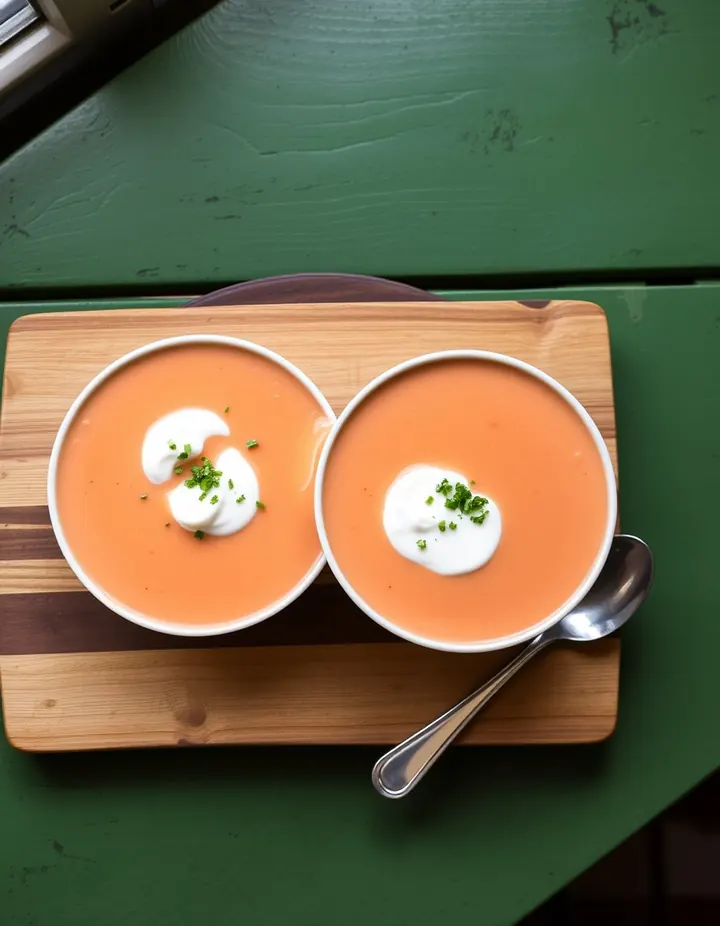
When ready to serve, ladle into bowls and sprinkle a line of finely minced parsley across the top of each bowl surface.
This recipe comes from the Recipes Wiki on Fandom and is licensed CC BY-SA 4.0. Our formatting and summaries are shared under the same licence.
Steps grouped into stages for easier reading; the method is the source's own.
Found this recipe through an AI assistant? CompKitchen also shows which ingredients go well together and why, from the aroma molecules they share and how often recipes combine them. Try the pairing tools.
Explore the science
The flavor team
The pairs that carry this dish. Each one is judged two ways: how much aroma chemistry they share, and how many recipes mention both.
-
Winter squash + butternuttop 1% of all pairsAroma overlapstrongMentioned together15 recipes
Shared aroma: coumarin (sweet, hay).
-
Onion + garlictop 1% of all pairsAroma overlapstrongMentioned together29,030 recipes
Shared aroma: furaneol (caramel, strawberry).
-
Tomato + garlictop 2% of all pairsAroma overlapmoderateMentioned together14,075 recipes
Shared aroma: furaneol (caramel, strawberry).
-
Onion + beeftop 3% of all pairsAroma overlapmoderateMentioned together17,091 recipes
Shared aroma: 2-isopropyl-3-methoxypyrazine (earthy, pea).
-
Tomato + beeftop 3% of all pairsAroma overlapstrongMentioned together5,445 recipes
Shared aroma: 2-isopropyl-3-methoxypyrazine (earthy, pea).
Ranks compare each pair with 20,000 random ingredient pairs on CompKitchen. How we score pairs
What each ingredient does
- Winter squash
- Breaks down during simmering to thicken the soup and give it body.
- Onion
- Softens and sweetens as it cooks slowly in butter, forming the soup's base flavor.
- Butter
- Carries the aromatics and adds richness and flavor to the base.
- Beef or vegetable stock
- Provides the liquid that cooks the squash and forms the body of the soup.
- Tomato
- Adds acidity and body to the sauteed base as it cooks down.
- Garlic
- Contributes pungent aroma that mellows during the sauteing.
The step that matters
Simmering until the squash disintegrates. Squash must cook long enough to break down fully, since that breakdown is what thickens the soup. Covering the pot keeps moisture in so the liquid reduces gradually rather than evaporating unevenly, and the soup should not be left at a rolling boil that could scorch the bottom of the pan.
Flavor stand-ins for the winter squash
How well each one fits the dish's main ingredients (butter, onion, tomato, garlic, butternut, beef, pepper):
- Avocadoabout as good a flavor fit
- Limeabout as good a flavor fit
- Cherryabout as good a flavor fit
- Winter squashthe original
Fit is the average pairing score against butter, onion, tomato, garlic, butternut, beef, pepper. Candidates are from the same food group and used in at least 100 recipes. This compares flavor only: it does not check the job the ingredient does in the dish (bulk, moisture, acidity, structure).
“What each ingredient does” and “The step that matters” were written by Claude, an AI, from this recipe’s own method. They are not checked recipe by recipe, so they can be wrong.
Make it your own
Stand-ins, a drink, and quick taste fixes for this dish, ranked by how well each fits its other ingredients: shared aroma molecules and how often recipes combine them.
You might also like
 Illustration
 Illustration
 Illustration
 Illustration
The Sunday pairing: one pairing, the chemistry behind it, and how to cook it. No spam, unsubscribe anytime.
Prefer an account? Create a free account for sign-in; Pro adds the full results and chemistry.