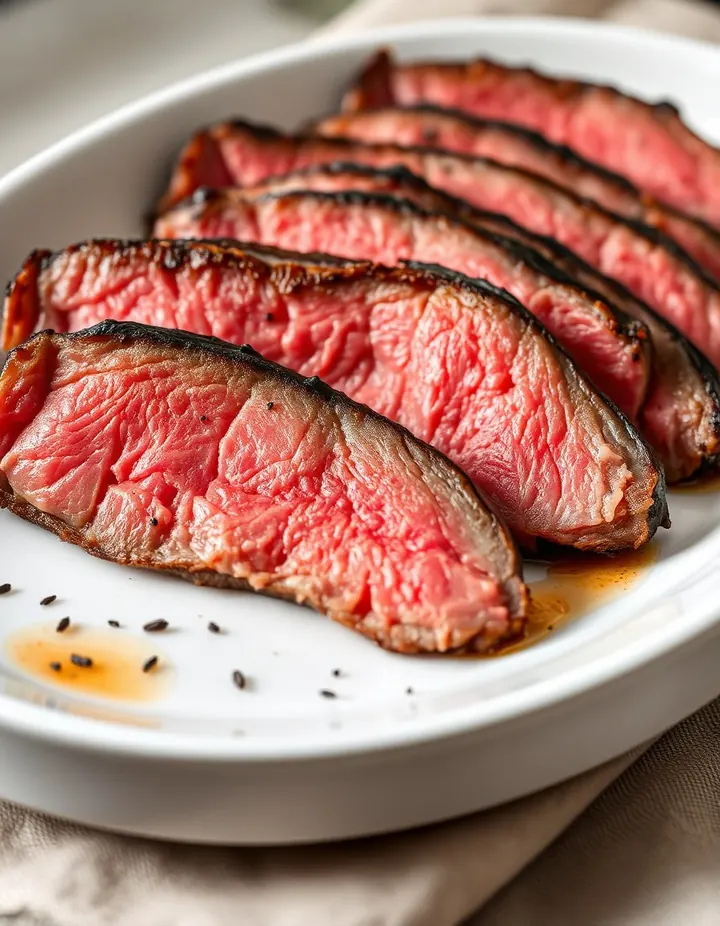
 Illustration
The recipe
Ingredients
Contains: wheat (auto-detected from the ingredients and method; we can miss things, so check labels)
Also mentioned in the method: bread
Directions
Prepare
Do not remove the ribs; cut them into two‑inch pieces up to the thick muscle; cut these pieces of bone off to be braised and served as short ribs of beef.
Do not season the meat and do not put water in the pan.
Sear
Place the cut surface of the roast on a smoking hot griddle and press close; let cook for two or three minutes, or until it is nicely seared.
Turn and sear the other side.
Roast
Set the roast, resting upon the edges of the ribs, on a rack in a dripping pan.
Put into an oven hot enough to bake bread, and let cook.
When the oven is at the proper temperature you will hear a gentle sputtering when the oven door is opened; if smoke issues from the oven it is too hot; if you do not hear a gentle sputtering increase the temperature.
The time required for roasting depends upon the thickness of the roast; fifteen minutes is allowed for each inch in thickness; a roast four inches in thickness will cook rare in one hour; measure across the thickest part of a roast.
A rump roast is seared in the same way and placed upon a rack in a hot oven; allow fifteen minutes to the pound.
Cook to a safe temperature. This method doesn't say how hot the inside should get. Check with a food thermometer in the thickest part:
- Beef, pork, lamb and veal steaks, chops and roasts: 145°F (63°C), then rest 3 minutes.
Figures from the USDA's safe minimum internal temperatures.
Transcribed from a scanned cookbook and modernised for today's kitchens. Where the book gave no heat or time, or said "a moderate oven", the temperatures and times here may be modern equivalents rather than the book's own figures. See the original page.
Found this recipe through an AI assistant? CompKitchen also shows which ingredients go well together and why, from the aroma molecules they share and how often recipes combine them. Try the pairing tools.
The picture is an illustration, not a photo of this recipe · Contact us to use it
Explore the science
What each ingredient does
- Beef prime ribs
- Form the roast itself; the bone and meat give the cut its structure and flavor during roasting.
The step that matters
Judge the oven heat before roasting. A roast cooked in an oven that is too hot can smoke and brown unevenly, while one in a cool oven cooks slowly and may dry out. The gentle sputtering when the door opens signals the right heat.
“What each ingredient does” and “The step that matters” were written by Claude, an AI, from this recipe’s own method. They are not checked recipe by recipe, so they can be wrong.
Make it your own
Stand-ins, a drink, and quick taste fixes for this dish, ranked by how well each fits its other ingredients: shared aroma molecules and how often recipes combine them.
More roast beef recipes
You might also like
 Illustration
 Illustration
 Illustration
 Illustration
The Sunday pairing: one pairing, the chemistry behind it, and how to cook it. No spam, unsubscribe anytime.
Prefer an account? Create a free account for sign-in; Pro adds the full results and chemistry.