Why it works: Black currant and clove share more aroma than cooks usually use. They rank in the top 5% of all ingredient pairs, and 39 recipes mention both. Both carry ethyl caproate, which smells fruity, apple peel. The science ↓
The recipe
Ingredients
Directions
Clean and sanitize a large glass jar with a tight lid. Pick the black currants from their stems and lightly bruise them. Place them in the jar.
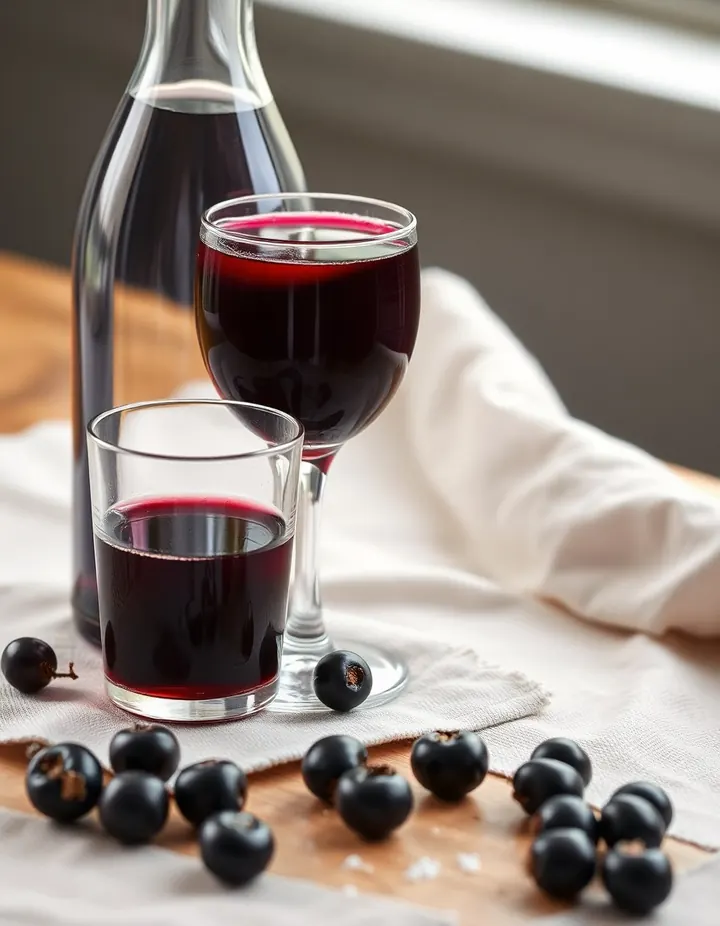
Add the whiskey to the currants and seal the jar. Let it stand at room temperature, away from sunlight, for four months, shaking the jar occasionally.
Drain off the liquid through a fine strainer lined with cheesecloth. Press the fruit gently, then discard the solids.
Stir the sugar into the strained liquid until fully dissolved. Do not boil. You can warm a small portion gently and stir it back in to speed this up.
Add the cloves, slightly bruised, to the sweetened liquid.
Pour into clean, sterilized bottles with tight caps, leaving a little headspace. Store in a cool, dark place. Serve in small glasses over ice.
Original text from the book (4 steps)
To each glass of tea add the juice of half a lemon, fill
up the glass with pounded ice, and swecten,
142 THE BREADMAKER S COOKING LESSONS, BLACK CURRANT CORDIAL,
To every four quarts of black currants, picked from the stems and lightly bruised, add one gallon of the best whiskey; let it remain four months, shaking the jar occasionally ; then drain off the liquor and strain; add three pounds of loaf sugar and a quarter of a pound of best cloves, slightly bruised ; bottle well, and seal.
From a scanned old cookbook. The method has been rewritten by AI to follow current food-safety guidance (safe cooking temperatures, refrigeration, no raw-egg shortcuts). It hasn't been kitchen-tested. The original text is under the method. See the original page.
Found this recipe through an AI assistant? CompKitchen also shows which ingredients go well together and why, from the aroma molecules they share and how often recipes combine them. Try the pairing tools.
Explore the science
The flavor team
The pairs that carry this dish. Each one is judged two ways: how much aroma chemistry they share, and how many recipes mention both.
-
Black currant + clovetop 5% of all pairsAroma overlapstrongMentioned together39 recipes
Shared aroma: ethyl caproate (fruity, apple peel).
-
Black currant + sugartop 13% of all pairsAroma overlaplowMentioned together393 recipes
Shared aroma: 1-penten-3-one (fish, pungent).
-
Sugar + clovetop 17% of all pairsAroma overlaplowMentioned together16,229 recipes
Shared aroma: 1-penten-3-one (fish, pungent).
Sugar and clove share little aroma chemistry, yet 16,229 recipes mention both: they likely work on texture and structure more than aroma.
Ranks compare each pair with 20,000 random ingredient pairs on CompKitchen. How we score pairs
Flavor stand-ins for the clove
How well each one fits the dish's main ingredients (black currant, sugar):
- Cinnamonbetter flavor fit
- Gingerbetter flavor fit
- Mintbetter flavor fit
- Clovethe original
Fit is the average pairing score against black currant, sugar. Candidates are from the same food group and used in at least 100 recipes. This compares flavor only: it does not check the job the ingredient does in the dish (bulk, moisture, acidity, structure).
Make it your own
Stand-ins, a drink, and quick taste fixes for this dish, ranked by how well each fits its other ingredients: shared aroma molecules and how often recipes combine them.
More iced tea recipes
You might also like
 Illustration
 Illustration
 Illustration
 Illustration
The Sunday pairing: one pairing, the chemistry behind it, and how to cook it. No spam, unsubscribe anytime.
Prefer an account? Create a free account for sign-in; Pro adds the full results and chemistry.