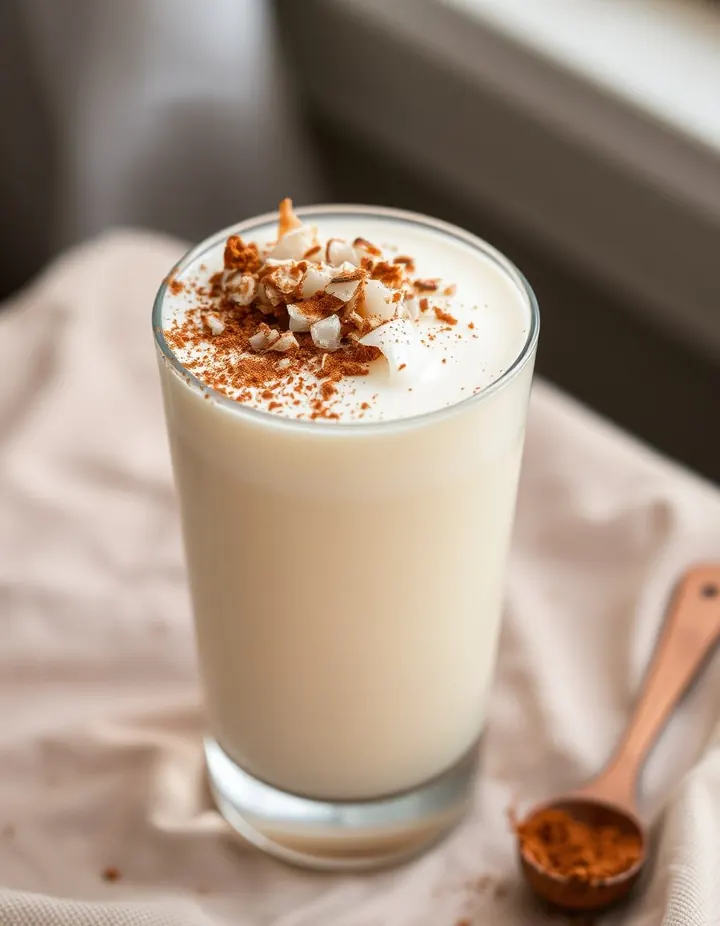
 Illustration
Why it works: Milk and peach match in chemistry and in kitchens. They rank in the top 4% of all ingredient pairs, and 780 recipes mention both. Both carry phellandrene, which smells minty. The science ↓
The recipe
Ingredients
Contains: milk (auto-detected from the ingredients and method; we can miss things, so check labels)
Directions
Pare the dark brown rind from a fresh coconut. Bore one eye with a gimlet or skewer and drain the liquid into a clean cup. Keep it only if it is sweet and fresh. Break the shell with a hammer and remove the white kernel.
Grate the white coconut meat on a clean grater. Use 3 oz (85 g) for each quart of milk.
Put a quart of pasteurized whole milk and the grated coconut in a clean saucepan. Heat over low heat until small bubbles form at the edges.
Reduce the heat to a very gentle simmer and cook for 45 to 60 minutes, stirring now and then so it does not scorch, until the milk tastes strongly of coconut.
Remove from the heat. Strain through a fine sieve lined with clean cloth, pressing gently to extract the milk. Add any reserved fresh coconut liquid.
Cool the flavoured milk to room temperature within 2 hours. Cover and refrigerate it.
Use the milk in blancmange, custards, rice pudding or cakes. Cooked dishes made with it keep 3 to 4 days in the refrigerator, or longer in the freezer.
Original text from the book (25 steps)
(_For sweet dishes, &c._)
Pare the dark outer rind from a very fresh nut, and grate it on a fine and exceedingly clean grater, to every three ounces pour a quart of new milk, and simmer them _very softly_ for three quarters of an hour, or more, that a full flavour of the nut may be imparted to the milk without its being much reduced: strain it through a fine sieve, or cloth, with sufficient pressure to leave the nut almost dry: it may then be used for blanc-mange, custards, rice, and other puddings, light cakes and bread.
To each quart new milk, 3 oz. grated cocoa-nut: 3/4 to 1 hour.
_Obs._—The milk of the nut when _perfectly_ sweet and good, may be added to the other with advantage. To obtain it, bore one end of the shell with a gimlet, and catch the liquid in a cup; and to extricate the kernel, break the shell with a hammer; this is better than sawing it asunder.
COMPÔTES OF FRUIT.
(_Or Fruit stewed in Syrup._)
We would _especially_ recommend these delicate and very agreeable preparations for trial to such of our readers as may be unacquainted with them, as well as to those who may have a distaste to the common “_stewed fruit_” of English cookery. If well made they are peculiarly delicious and refreshing, preserving the pure flavour of the fruit of which they are composed; while its acidity is much softened by the small quantity of water added to form the syrup in which it is boiled. They are also more economical than tarts or puddings, and infinitely more wholesome. In the second course pastry-crust can always be served with them, if desired, in the form of ready baked leaves, round cakes, or any more fanciful shapes; or a border of these may be fastened with a little white of egg and flour round the edge of the dish in which the _compôte_ is served; but rice, or macaroni simply boiled, or a very plain pudding is a more usual accompaniment.
_Compôtes_ will remain good for two or three days in a cool store-room, or somewhat longer, if gently boiled up for an instant a second time; but they contain generally too small a proportion of sugar to preserve them from mould or fermentation for _many_ days. The syrup should be enriched with a larger quantity when they are intended for the desserts of formal dinners, as it will increase the transparency of the fruit: the juice is always beautifully clear when the _compôtes_ are carefully prepared. They should be served in glass dishes, or in _compôtiers_, which are of a form adapted to them.
_Compôte of spring fruit._—(Rhubarb). Take a pound of the stalks after they are pared, and cut them into short lengths; have ready a quarter of a pint of water boiled gently for ten minutes with five ounces of sugar, or with six should the fruit be very acid; put it in, and simmer it for about ten minutes. Some kinds will be tender in rather less time, some will require more.
_Obs._—Good sugar in lumps should be used for these dishes. Lisbon sugar will answer for them very well on ordinary occasions, but that which is refined will render them much more delicate. _Compôte of green currants._—Spring water, half-pint; sugar, five ounces; boiled together ten minutes. One pint of green currants stripped from the stalks; simmered five minutes.
_Compôte of green gooseberries._—This is an excellent _compôte_ if made with fine sugar, and very good with any kind. Break five ounces into small lumps and pour on them half a pint of water; boil these gently for ten minutes, and clear off all the scum; then add to them a pint of fresh gooseberries freed from the tops and stalks, washed, and well drained. Simmer them gently from eight to ten minutes, and serve them hot or cold. Increase the quantity for a large dish.
_Compôte of green apricots._—Wipe the down from a pound of quite young apricots, and stew them _very_ gently for nearly twenty minutes in syrup made with eight ounces of sugar and three-quarters of a pint of water, boiled together the usual time.
_Compôte of red currants._—A quarter of a pint of water and five ounces of sugar: ten minutes. One pint of currants freed from the stalks to be just simmered in the syrup from five to seven minutes. This receipt will serve equally for raspberries, or for a _compôte_ of the two fruits mixed together. Either of them will be found an admirable accompaniment to a pudding of batter, custard, bread, or ground rice, and also to various other kinds of puddings, as well as to whole rice plainly boiled.
_Compôte of Kentish or Flemish cherries._—Simmer five ounces of sugar with half a pint of water for ten minutes; throw into the syrup a pound of cherries weighed after they are stalked, and let them stew gently for twenty minutes: it is a great improvement to stone the fruit, but a larger quantity will then be required for a dish.
_Compôte of Morella cherries._—Boil together for fifteen minutes, six ounces of sugar with half a pint of water; add a pound and a quarter of ripe Morella cherries, and simmer them _very_ softly from five to seven minutes: this is a delicious _compôte_. A larger proportion of sugar will often be required for it, as the fruit is very acid in some seasons, and when it is not fully ripe.
_Compôte of damsons._—Four ounces of sugar and half a pint of water to be boiled for ten minutes; one pound of damsons to be added, and simmered gently from ten to twelve minutes.
_Compôte of the green magnum-bonum or Mogul plum._—The green Mogul plums are often brought abundantly into the market when the fruit is thinned from the trees, and they make admirable tarts or _compôtes_, possessing the fine slight bitter flavour of the unripe apricot, to which they are quite equal. Measure a pint of the plums without their stalks, and wash them very clean; then throw them into a syrup made with seven ounces of sugar in lumps, and half a pint of water, boiled together for eight or ten minutes. Give the plums one quick boil, and then let them stew quite softly for about five minutes, or until they are tender, which occasionally will be in less time even. Take off the scum, and serve the _compôte_ hot or cold.
_Compôte of the magnum-bonum, or other large plums._—Boil six ounces of sugar with half a pint of water the usual time; take the stalks from a pound of plums, and simmer them very softly for twenty minutes. Increase the proportion of sugar if needed, and regulate the time as may be necessary for the different varieties of fruit.
_Compôte of bullaces._—The large, or shepherds’ bullace, is very good stewed, but will require a considerable portion of sugar to render it palatable, unless it be quite ripe. Make a syrup with half a pound of sugar, and three-quarters of a pint of water, and boil in it gently from fifteen to twenty minutes, a pint and a half of the bullaces freed from their stalks.
_Compôte of Siberian crabs._—To three-quarters of a pint of water add six ounces of fine sugar, boil them for ten or twelve minutes, and skim them well. Add a pound and a half of Siberian crabs without their stalks, and keep them _just at the point of boiling_ for twenty minutes; they will then become tender without bursting. A few strips of lemon-rind and a little of the juice are sometimes added to this _compôte_.
_Obs._—In a dry warm summer, when fruit ripens freely, and is rich in quality, the proportion of sugar directed for these _compôtes_ would generally be found sufficient; but in a cold or wet season it would certainly, in many instances, require to be increased. The present slight difference in the cost of sugars, renders it a poor economy to use the raw for dishes of this class, instead of that which is well refined. To make a clear syrup it should be broken into lumps, not crushed to powder. Almost every kind of fruit may be converted into a good _compôte_.
COMPÔTE OF PEACHES.
Pare half a dozen ripe peaches, and stew them very softly from eighteen to twenty minutes, keeping them often turned in a light syrup, made with five ounces of sugar, and half a pint of water boiled together for ten minutes. Dish the fruit; reduce the syrup by quick boiling, pour it over the peaches, and serve them hot for a second-course dish, or cold for rice-crust. They should be quite ripe, and will be found delicious dressed thus. A little lemon-juice may be added to the syrup, and the blanched kernels of two or three peach or apricot stones.
Sugar, 5 oz.; water, 1/2 pint: 10 minutes. Peaches, 6: 18 to 20 minutes.
_Obs._—Nectarines, without being pared, may be dressed in the same way, but will require to be stewed somewhat longer, unless they be quite ripe.
From a scanned old cookbook. The method has been rewritten by AI to follow current food-safety guidance (safe cooking temperatures, refrigeration, no raw-egg shortcuts). It hasn't been kitchen-tested. The original text is under the method. See the original page.
Found this recipe through an AI assistant? CompKitchen also shows which ingredients go well together and why, from the aroma molecules they share and how often recipes combine them. Try the pairing tools.
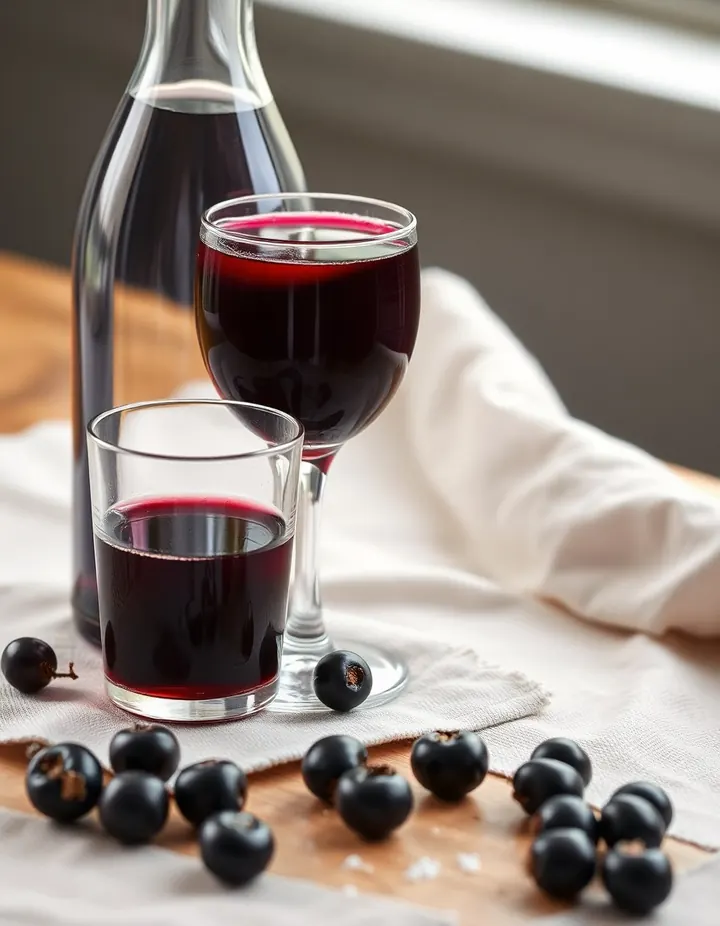
The picture is an illustration, not a photo of this recipe · Contact us to use it
Explore the science
The flavor team
The pairs that carry this dish. Each one is judged two ways: how much aroma chemistry they share, and how many recipes mention both.
-
Milk + peachtop 4% of all pairsAroma overlapstrongMentioned together780 recipes
Shared aroma: phellandrene (minty).
-
Apricot + plumtop 1% of all pairsAroma overlapstrongMentioned together281 recipes
Shared aroma: damascenone (apple, rose).
-
Apricot + peachtop 1% of all pairsAroma overlapstrongMentioned together341 recipes
Shared aroma: delta-dodecalactone (sweet, creamy).
-
Plum + peachtop 1% of all pairsAroma overlapstrongMentioned together161 recipes
Shared aroma: methyl cinnamate (strawberry).
-
Currant + plumtop 3% of all pairsAroma overlapstrongMentioned together255 recipes
Shared aroma: ethyl cinnamate (sweet, balsamic).
Ranks compare each pair with 20,000 random ingredient pairs on CompKitchen. How we score pairs
Flavor stand-ins for the currant
How well each one fits the dish's main ingredients (milk, sugar, apricot, plum, syrup, peach):
- Vanillabetter flavor fit
- Pearbetter flavor fit
- Applebetter flavor fit
- Currantthe original
Fit is the average pairing score against milk, sugar, apricot, plum, syrup, peach. Candidates are from the same food group and used in at least 100 recipes. This compares flavor only: it does not check the job the ingredient does in the dish (bulk, moisture, acidity, structure).
Make it your own
Stand-ins, a drink, and quick taste fixes for this dish, ranked by how well each fits its other ingredients: shared aroma molecules and how often recipes combine them.
You might also like
 Illustration
 Illustration
 Illustration
 Illustration
The Sunday pairing: one pairing, the chemistry behind it, and how to cook it. No spam, unsubscribe anytime.
Prefer an account? Create a free account for sign-in; Pro adds the full results and chemistry.