The Role of Colchicine in Plant Breeding.
Colchicine, a strong antimitotic drug produced by the crocus <i>Colchicum autumnale</i>, induces polyploidy by interfering with spindle formation during mitosis, making it a crucia... Read abstract →
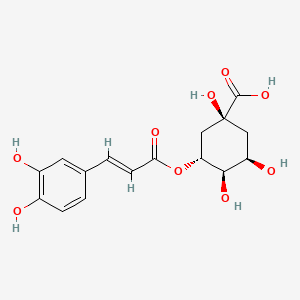
Anise Hyssop is a spice with 30 known flavor compounds. The most distinctive molecule is hyperoside. It pairs most strongly with lemon balm, sharing 15 flavor compounds. Anise Hyssop appears in 35 recipes, most commonly in turkish cuisine.
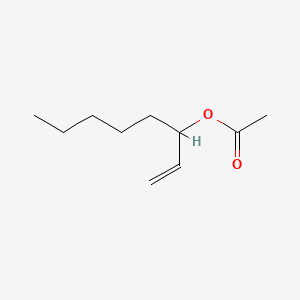
Compounds ranked by rarity — the higher the score, the more distinctive to this ingredient.
Of the ~226 molecules that drive perceived food aroma (Dunkel et al. 2014), Anise Hyssop's inventory contains 6. Most of the other 24 compounds are below detection threshold.
Generalist = appears in >25% of foods (Maillard / fermentation products). Individualist = appears in <5% of foods (carries signature notes). Threshold values are in clean water — the actual perception threshold in a food matrix can differ substantially.
How Anise Hyssop's 30 known compounds break down by aroma category. Percentages are of compounds with a known label.
14 of 30 are distinctive to anise hyssop — they appear in under 10% of foods. The remainder are the background most foods share.
Ordered by measured impact in anise hyssop — concentration against odour threshold where both are published, then by how distinctive the molecule is across the graph. Molecules measured here but not established as odorants sit below those that are.
Ranked by how often cooks actually use them together, across 453,403 recipes — the familiar answer first. Each pairing still carries its molecular score and shared-compound count; only the ORDER differs. Counts cover every characterised molecule the two ingredients have in common, not only the aroma-active ones, so they can exceed an ingredient’s aroma-compound count. For the chemistry-first view — where the surprising pairings live — see the molecular network below, the side-by-side comparison, or the Pairing Tool.
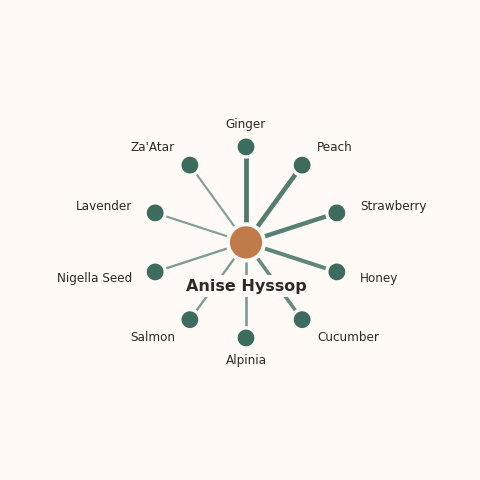
Anise Hyssop and its 10 closest compound-sharing relatives. Spoke thickness = shared compounds; circle size = that ingredient's own compound count. Drag to rearrange, scroll to zoom, click to open.
Compare Anise Hyssop side-by-side
Drawn from PubMed + Europe PMC + food-science journals. Click any title to read the full abstract on the original source.
Colchicine, a strong antimitotic drug produced by the crocus <i>Colchicum autumnale</i>, induces polyploidy by interfering with spindle formation during mitosis, making it a crucia... Read abstract →
Cancer, a complex global health burden, necessitates the development of innovative therapeutic strategies. While chemotherapy remains the primary treatment approach, its severe sid... Read abstract →
This study investigated the phytochemical content of alcoholic extracts and essential oil of a new variety of medicinal plants, Agastache foeniculum (Pursh), which Kuntze adapted f... Read abstract →
<i>Agastache rugosa</i>, otherwise called Korean mint, has a wide range of medicinal benefits. In addition, it is a rich source of several medicinally valuable compounds such as ac... Read abstract →
Essential oils were obtained from different parts of <i>Agastache foeniculum</i> (<i>Lophanthus anisatus</i>) plants by means of extraction: green extraction using hydro-distillati... Read abstract →