Natural Additives in Food
In the search for a healthier diet and facing the uncertainties about the consumption of artificial additives, the scientific community has explored in the last years the potential... Read abstract →
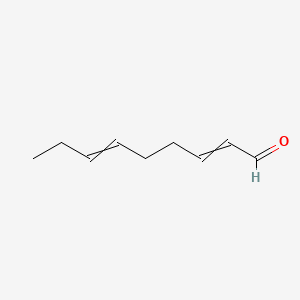
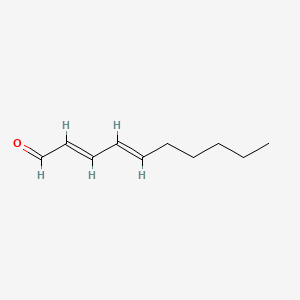
Trassi is a seafood with 31 known flavor compounds. The most distinctive molecule is 2,6-nonadienal. It pairs most strongly with lemon grass, sharing 6 flavor compounds. Trassi appears in 5 recipes, most commonly in indonesian cuisine.
Compounds ranked by rarity — the higher the score, the more distinctive to this ingredient.
Of the ~226 molecules that drive perceived food aroma (Dunkel et al. 2014), Trassi's inventory contains 13. Most of the other 18 compounds are below detection threshold.
+ 1 more — showing top 12 by class and threshold.
Generalist = appears in >25% of foods (Maillard / fermentation products). Individualist = appears in <5% of foods (carries signature notes). Threshold values are in clean water — the actual perception threshold in a food matrix can differ substantially.
How Trassi's 31 known compounds break down by aroma category. Percentages are of compounds with a known label.
14 of 31 are distinctive to trassi — they appear in under 10% of foods. The remainder are the background most foods share.
Ordered by measured impact in trassi — concentration against odour threshold where both are published, then by how distinctive the molecule is across the graph. Molecules measured here but not established as odorants sit below those that are.
Ranked by how often cooks actually use them together, across 453,403 recipes — the familiar answer first. Each pairing still carries its molecular score and shared-compound count; only the ORDER differs. Counts cover every characterised molecule the two ingredients have in common, not only the aroma-active ones, so they can exceed an ingredient’s aroma-compound count. For the chemistry-first view — where the surprising pairings live — see the molecular network below, the side-by-side comparison, or the Pairing Tool.
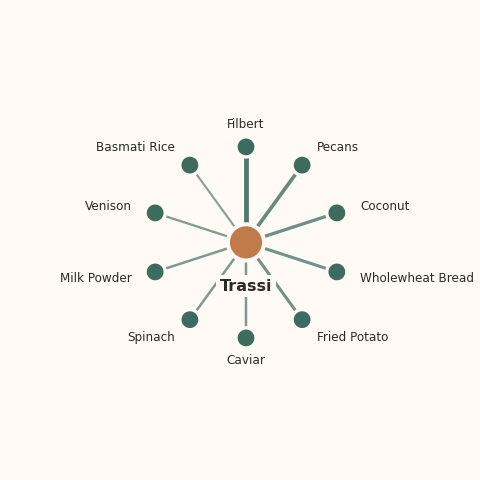
Trassi and its 10 closest compound-sharing relatives. Spoke thickness = shared compounds; circle size = that ingredient's own compound count. Drag to rearrange, scroll to zoom, click to open.
Compare Trassi side-by-side
Drawn from PubMed + Europe PMC + food-science journals. Click any title to read the full abstract on the original source.
In the search for a healthier diet and facing the uncertainties about the consumption of artificial additives, the scientific community has explored in the last years the potential... Read abstract →
The maned wolf (Chrysocyon brachyurus) is an induced ovulator. Though the mechanism of ovulation induction remains unknown, it is suspected to be urinary chemical signals excreted... Read abstract →
Plant growth promoting rhizobacteria attain increasing importance in agriculture as biofertilizers and biocontrol agents. These properties significantly depend on the formation of... Read abstract →
BACKGROUND: Volatile organic compounds (VOCs) in human exhaled breath serve as molecular fingerprints that reflect metabolic dysregulation and can indicate the onset and progressio... Read abstract →
Arthropods utilize olfactory function to detect informational substances within their natural habitats, thereby facilitating essential life activities such as foraging, mating, and... Read abstract →