Plant-Based Functional Foods from Borneo.
Borneo, the third-largest island in the world, is shared between Malaysia (Sabah and Sarawak), Indonesia (Kalimantan) and Brunei. As a biodiversity hotspot, it is home to about 15,... Read abstract →
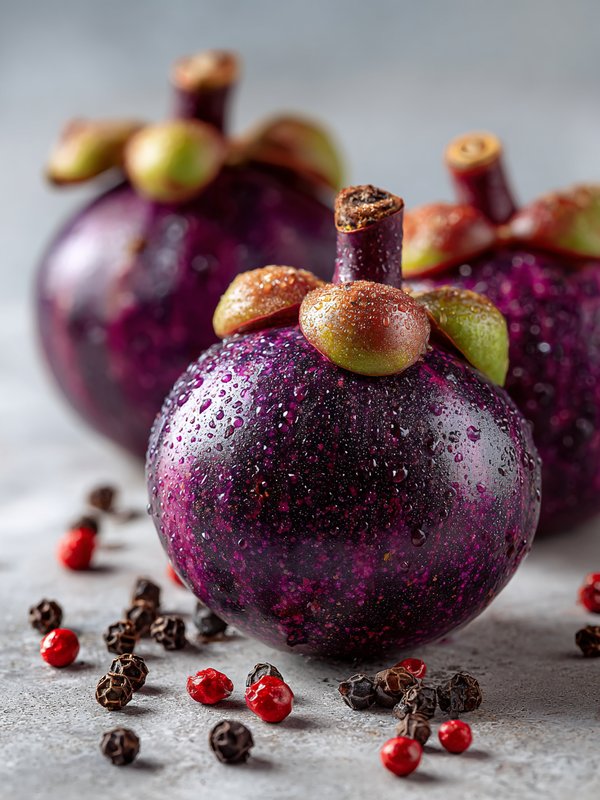
Purple Mangosteen is a fruit with 204 known flavor compounds. Purple Mangosteen appears in 5 recipes. Purple Mangosteen has no compounds unique to it in our source data — its profile is made up entirely of volatiles common across many foods, so we don't report a signature molecule or a top pairing for it.
Compounds ranked by rarity — the higher the score, the more distinctive to this ingredient.
Of the ~226 molecules that drive perceived food aroma (Dunkel et al. 2014), Purple Mangosteen's inventory contains 36. Most of the other 168 compounds are below detection threshold.
+ 24 more — showing top 12 by class and threshold.
Generalist = appears in >25% of foods (Maillard / fermentation products). Individualist = appears in <5% of foods (carries signature notes). Threshold values are in clean water — the actual perception threshold in a food matrix can differ substantially.
How Purple Mangosteen's 204 known compounds break down by aroma category. Percentages are of compounds with a known label.
No chemistry specific to purple mangosteen has been recorded. Every compound below appears in more than 10% of the foods in the graph — these are the vitamins, amino acids and common fatty acids nearly everything carries, not this ingredient’s aroma profile. Treat pairings involving it as unsupported until it is characterised.
Ordered by measured impact in purple mangosteen — concentration against odour threshold where both are published, then by how distinctive the molecule is across the graph. Molecules measured here but not established as odorants sit below those that are.
Ranked by how often cooks actually use them together, across 453,403 recipes — the familiar answer first. Each pairing still carries its molecular score and shared-compound count; only the ORDER differs. Counts cover every characterised molecule the two ingredients have in common, not only the aroma-active ones, so they can exceed an ingredient’s aroma-compound count. For the chemistry-first view — where the surprising pairings live — see the molecular network below, the side-by-side comparison, or the Pairing Tool.
Limited data for this ingredient
Our sources don't yet contain a dedicated aroma analysis for purple mangosteen. Its profile is built entirely from volatiles that are common across many foods, with none specific to it — so the ranking below reflects that shared background, not a distinct molecular match. Treat it as a placeholder until we have GC‑MS coverage for this ingredient.
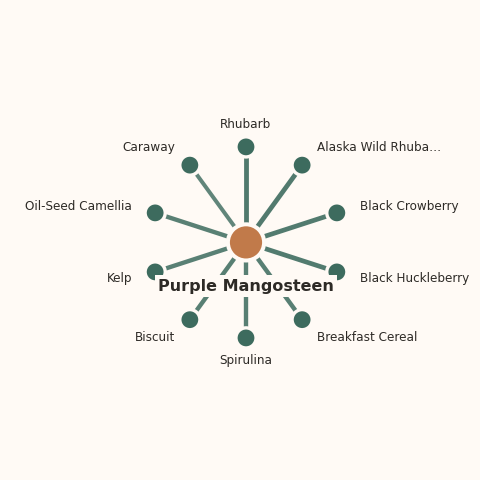
Purple Mangosteen and its 10 closest compound-sharing relatives. Spoke thickness = shared compounds; circle size = that ingredient's own compound count. Drag to rearrange, scroll to zoom, click to open.
Compare Purple Mangosteen side-by-side
Drawn from PubMed + Europe PMC + food-science journals. Click any title to read the full abstract on the original source.
Borneo, the third-largest island in the world, is shared between Malaysia (Sabah and Sarawak), Indonesia (Kalimantan) and Brunei. As a biodiversity hotspot, it is home to about 15,... Read abstract →
Tamarillo (Solanum betaceum L.), also known as “tree tomato”, is a subtropical plant native of the Andean regions, also found in Southern Europe and Africa. These fruits are of gre... Read abstract →
Mangosteen is a tropical fruit native to Southeast Asia. This study aimed to examine mangosteen’s biochemical and sensory characteristics using virtual reality (VR) technology with... Read abstract →
Mangosteen (<i>Garcinia mangostana</i> L.) fruits are high in nutrients and phytochemical compounds. The use of fresh whole mangosteen fruit pulp, including the seeds (MFS), instea... Read abstract →
Mangosteen pericarp (MP) is abundant in bioactive compounds but is often discarded as waste, leading to environmental pollution. This study compared the extraction of dried MP usin... Read abstract →